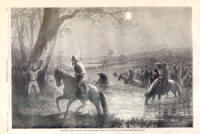
South Mountain by Rick Reeve

South Mountain by Rick Reeve
South Mountain by Rick Reeve depicting the wounding of General Garland
Showing posts with label Commanders. Show all posts

Sunday, August 12, 2012

"never a more plucky or determined fighter.": Major General Daniel H. Hill

   Commanding a division of roughly 5,000 men,  Daniel Hill found himself facing the entire Union army advancing towards his position at South Mountain. Determined to hold the vital passes, Hill deployed two brigades and ordered up his remaining brigades to his headquarters at the Mountain House for deployment.With three mountain passes to hold and limited manpower, Hill initiated the battle that would buy time for Confederate forces at Harper's Ferry.  James Longstreet described Hill as a "plucky...determined fighter." and his pluckiness and determination would show on September 14th and with help on the way from Hagerstown, several miles away, the question was, would Hill's determination and pluckiness help his men hold until help arrived?

Daniel Harvey Hill was born on July 12, 1821 in York District (County),  South Carolina to Nancy and Solomon Hill. Hill would lose his father when he was only four and his mother would raise him and his 10 siblings. While he was a child, Hill was surely exposed to stories of war, his paternal grandfather had an iron works that supplied cannon to the Continental Army during The Revolution and his maternal grandfather was a scout for revolutionary general Thomas Sumter. Hearing the family history and his mother raising him as a dedicated christian, Hill accepted that slavery was a part of the southern way of life and that southerners had played a vital, if not the most important, role in winning the American Revolution. This belief shaped the young Hill's mind to despise anything related to the north.

In 1838, Hill was nominated for appointment to the United States Military Academy at West Point, New York. Hill was an average cadet during his time at West Point and he would graduate in 1842 ranked 28th out of a class of 56. A class that included future civil war generals John Pope, Lafayette McLaws, Abner Doubleday, and James Longstreet. Following his graduation, Hill was assigned to the artillery and he would see action during the Mexican-American War, receiving acclaim for actions during the war. Upon returning from war, Hill would marry Isabella Morrison in November 1848 and in early 1849, he would resign from the army and move to Lexington, Virginia, where he would become a teacher at the Washington College. During this time he would become friends with Thomas J. Jackson, later to be known as Stonewall, and assisted with getting Jackson employment at the Virginia Military Institute.  While teaching at Washington College, Hill would be held in high esteem by his students despite, in the descriptions, his unorganized appearance despite having been an officer in the army.

Hill's stay in Lexington would be short however because in 1854, he would be offered a teaching position at Davidson College. Hill was familiar with the school because his father-in-law had been the first president of the school. Accepting the position was not an easy choice. He had wished to remain in Lexington but his convictions about his religious beliefs were at base of what Davidson was founded upon. When Hill arrived on the campus of Davidson, the college was overrun by undisciplined students that were threatening to close the school. Hill was given the full approval by the schools board of trustees to do whatever was necessary.

What awaited Hill was pure chaos. The students of the school were so undisciplined that riots were weekly occurrences, drunkenness was rampant and when students were suspended for their actions, they remained on campus, causing more mischief.  Examples of such mischief was the attack on professors homes by a mob of students with rocks and eggs and another incident involved gunpowder being put into a candle snuffer that caused serious injury to the person that used it.  Arriving on campus in May 1854, Hill immediately went about restoring order. He created a merit system similar to that which was in use at most colleges in the country at the time, including the USMA. Hill even went as far as stating that the college was in such a condition because of the current college president, Samuel Williamson. The friction between the two eventually lead to Williamson's resignation and Hill even went as far to offer his, but the board of trustees refused to allow him to leave. Over the coming months, the new discipline system bucked against that students and one night they rioted like never before. Again, they assaulted a professor's home with rocks and eggs. During this riot, Hill was struck by a stone and it was here that he decided enough was enough. He gathered the school's faculty, there were only four, to canvass the dorms to ensure which students had remained in their rooms. What occurred next exemplified what Hill was there for. He would suspend one student for three months, a student known to be a instigator of the troubles around campus. The suspension caused students, nearly half, to sign a petition demanding the student to be re-instated. When Hill and the board refused, many left the school. Hill's belief that a school was for students to study and further there lives in a disciplined manner ruled the day. With this action, Hill had all but restored order to the school and he also improved the schools academic program, especially in the mathematics department. His actions also caused a wealthy donor to give nearly $300,000. Hill's tenure would end in 1859 when he resigned to become superintendent of the North Carolina Military Institute.

North Carolina Military Institute, circa 1870
The North Carolina Military Institute had just been constructed and Hill would oversee the schools first class of 60 cadets beginning in October 1859.  The school was constructed to be similar to the military academy at West Point and has the schools first superintendent, D.H. Hill set about creating an order of discipline that was similar to that which he had experienced at West Point, his time in the army, and that which he had instilled at Davidson. Christianity also played a central role in the belief system at the school. Cadets were instructed to go to chapel twice daily, once to hear a sermon and once to receive biblical instruction, lead by Hill. The cadets were also to attend church on Sundays.

Life at the institute revolved around church, academics, and daily drill until December 1861 when South Carolina declared it was seceding from the Union. Many of the students at the school were South Carolinian, including some instructors. They contemplated withdrawing from the school to go home to take part in the events occurring there. Hill advised the students to remain in school until it was certain a war, which many believed was to occur, would take place. One instructor, in later years, believed that Hill, while supporting the southern way of life, did not want to fight in its defense until absolutely necessary.

Unfortunately, war would come when on April 12, 1861, forces from the recently created Confederate States of American fired on Fort Sumter, a United States military installation. Hill would gather his students at the institutes chapel to lecture them on what would should be expected in the coming war and unlike those that believed it would be a short war, Hill told his cadets it would be a long war, possibly has long as the Revolution and that each one would get their share of it. In the weeks ahead, Hill would be summoned to the state capital to set up a camp of instruction for North Carolina's volunteers. His cadets would join him to assist in the training of these volunteers.

As he was a prominent figure in North Carolina and possessed military experience, Hill was made colonel of the 1st North Carolina regiment in May 1861 and he would soon find himself in Virginia leading his North Carolinian's in their first taste of battle at Big Bethel on June 10, 1861 in what would be an overwhelming Confederate victory, in part due to confusion within the Union ranks that lead to a friendly fire incident. Hill's leadership during this fight would lead to his promotion to brigadier general on July 10th. With his new rank, Hill would remain in Virginia, commanding troops on the Virginia Peninsula near Richmond until his transfer to North Carolina where he would spend several weeks assisting with the construction and strengthening of coastal defenses. Upon the completion of this assignment, Hill would again find himself commanding a brigade of North Carolinans under Joseph Johnston defending Leesburg, Virginia.  He would remain here, leading his brigade for the remainder of the winter. In March 1862, Joseph Johnston pulled his army back to a more defensible position and Hill would be promoted to Major General. Eventually, Hill would be with his division in the Confederate defenses near Yorktown, Virginia facing the massive Army of the Potomac under George B. McClellan.

Fighting an unbalanced artillery dual with Union artillery (Confederate ammunition was anything but reliable), Johnston would order his army to retreat back towards Richmond. Hill's division would assisted with covering the withdrawal and one of his brigades, under Jubal Early, would engage Union forces at Williamsburg. As Early moved with his brigade towards the sound of fighting, Hill accompanied him. As the Confederates deployed, Early divided his brigade and lead two regiments towards what he believed was the Union flank. Instead, he would run head-on into the Union line and the two regiments of Virginian's he led into the battle suffered terribly. Hill would bring up reinforcements, the 5th North Carolina, and he would personally lead the regiment into the fight but soon saw the futility and ordered a withdrawal. The Confederate retreat continued until they reach Richmond's outer defenses.

For Hill, the retreat and slaughter of his men at Williamsburg disheartened him. Reaching the defenses of Richmond, Hill found himself in a position to gain retribution against those Union men in blue. Joseph Johnston, needing to strike a blow, organized a plan that would through most of his army against an isolated portion of the Union army located near Seven Pines, a small village east of Richmond on the Williamsburg Road. The plan called for several Confederate columns to advance in columns along several roadways and converge on the Union positions, cutting them off from the main army. The plan went shambles from the beginning. Instead of advancing in seperate columns, the Confederates under James Longstreet advanced on the same road as D.H. Hill's division and other Confederate divisions did not get underway until late in the day. Knowing the battle was to open, but seeing no troops or hearing musketry, Hill became inpatient and order his division forward, opening the fight around 1 p.m. For the next several hours, Hill's division bore the brunt of the fight and captured the first Union defensive line. With reinforcement from Longstreet, Hill pushed on hitting the second defensive line at roughly 4:30 and facing fierce resistance. A flank attack by Colonel Micah Jenkins, sealed the victory on May 31st for the Confederates. With fighting dying down, the Confederate rested on there hard won laurels but a momentous event had taken place. In the late evening, arriving on the battlefield for a first hand report, General Joseph Johnston was severely wounded by a shell fragment with command falling to Gustavus Smith, who would lead the army's unsuccessful attacks on the following day, forcing a Confederate withdrawal. With Smith seemingly having a nervous breakdown at the time, Confederate President Jefferson Davis appointed Robert E. Lee to command the army defending Richmond.

For the better part of the next month, Lee would strengthen the Richmond defenses and eventually Hill would find himself, with his division, under the command of his brother-in-law Stonewall Jackson. While the majority of southerners believed that Lee was actually digging in to await the massive Union armies final assault on Richmond, he was strengthening the defenses to be capable of holding the lines with a smaller force while taking the bulk to attack McClellan and push his army back from Richmond. General Hill would serve an important role in this attack. As part of Jackson's wing of the army, he would lead his division in a wide flanking movement that would bring him into the rear areas of the Union 5th Corps, in fortifications near the hamlet of Mechanicsville. In the ensuing week, Hill would lead his division in a supporting role at Beaver Dam Creek, the attack at Gaines Mill, and finally in the bloody repulse at Malvern Hill, where he stated that the attack was "not war, but murder". All in all, the fighting that took place on the Peninsula, Hill established himself as a capable field commander. Hill would lead his division back their camps around Richmond for much needed rest, after spending a better part of a week after the fight at Malvern Hill gathering arms, equipment, caring for the wounded, and burying the dead of both sides. Hill's division would lose roughly 4,000 men as casualties during the week long fight.

Following the successful repulse of McClellan from the gates of Richmond, Lee would turn his eye to the north to deal with a new Union threat, the Army of Virginia, under the command of Major General John Pope, that was decimating northern Virginia. While Lee would move north with the majority of his army, he would leave behind Hill commanding forces to the south of the James River near Richmond to keep a watchful eye on McClellan's force, that was still standing in a semi-threatening posture at Harrison's Landing. While Lee was marching northward to see what could be done against Pope, Hill was ordered to harass the communications of McClellan. Hill would order a small force and several artillery batteries and go into position at Coggin's Point, opposite the Union camp at Harrison's Landing. The Confederates would open up on the Union camp on the night of July 31st and August 1st, causing confusion and damaging several ships that were docked at the landing. Hill's men would fire nearly 1,000 rounds of artillery on the encampment before being driven off by Union counter-battery fire. Not long after abandoning their position at Coggin's Point, Union troops crossed the James River and occupied the position.

Hill remain in overall command of Confederate forces in the area south of the James River covering that approach to Richmond as well as the vital railway link at Petersburg, Virginia. Around the middle of August, Hill reported that McClellan was evacuating the Peninsula. During the manuvering in northern Virginia, Confederate cavalry captured John Pope's headquarters baggage and other materials that provided information that McClellan was moving to link up with Pope's army, a move that would seriously threaten and outnumber Lee's army. With this information, Lee requested that all available forces that could be spared be sent from Richmond to strengthen his army against the growing Union threat. By the end of August, Hill was leading his division northward, missing the Confederate victory at Second Manassas.  Linking up with the Army of Northern Virginia near Leesburg, Virginia on September 3, Hill would find himself as the spearhead for a movement northward, into Maryland.

On September 4th, Hill would be ordered by General Lee to demonstrate and cross the Potomac River. Sending one of his brigades to harass a Union positions near Berlin, Maryland while leading two other brigades across the Potomac near the mouth of the Monocacy River. After driving off Union pickets, the brigades set out destroying the Cheasapeake and Ohio Canal's banks, locks, and attempted to destroy the Monocacy Aqueduct, but we unable to due to lack of powder. Hill would lead his division as part of Jackson's command towards Frederick, encamping outside the city on September 5th. To note, Hill would find himself in command of all Confederate forces in Maryland prior to the arrival of Jackson on the Maryland shore, when Jackson would resume command responsibilities. Hill would also briefly be in command of Jackson's command when Jackson suffered a fall from a horse.

The Confederate forces would remain in and around Frederick until September 10th. Lee when moving into Maryland and marching on Frederick intended to force Union garrisons at Martinsburg and Harper's Ferry to abandon their positions allowing the Confederates to establish a secure line of communication and supply through the Shenandoah Valley in preparation for a possible advance into Pennsylvania. When this did not happen, Lee produced Special Orders 191 that outlined the capture of Harper's Ferry by Jackson, who would lead over half the army in the effort. The remainder of the army would advance to Boonsborough where they would await developments. The movement began on the 10th and Hill would be part of the Confederate concentration at Boonsborough with two divisions from James Longstreet's command. Arriving in Boonsborough, Longstreet received reports of a Union force advancing from Pennsylvania in the direction of Hagerstown. Taking his two divisions, Longstreet advanced and took possession of Hagerstown taking control the vital hub.

With this, Hill would find himself alone in Boonsborough to act as rear guard  for the "main body" at Hagerstown and to keep an eye on roads south for any attempted escape by Union forces from Harper's Ferry. Hill would also provide infantry support for Jeb Stuart's cavalry that was covering the Confederate movement from Frederick. Hill first crisis would come on September 13, when Stuart requested infantry support for his hard-pressed cavalryman. Believing he was only facing two Union brigades, Stuart requested one infantry brigade to assist holding Turner's Gap on South Mountain. Hill instead ordered two brigades, those of Alfred Colquitt and Samuel Garland to march towards the gap while concentrating his remaining three brigades near Boonsborough.

Mountain House, Turner's Gap
On the morning of the 14th, per orders from General Lee, Hill went to Turner's Gap to reconoiter and assisted Stuart with the defense. Arriving at the Mountain House (present-day South Mountain Inn), Hill found Stuart preparing to depart and stating his plans for going to Crampton's Gap, believing that the threat was minimal. With the departure of Stuart, Hill set about the task of deploying his division. Arriving on the mountain, Hill found Colquitt's brigade at the eastern base of the mountain and Garland's brigade near the Mountain House. Surveying the position, Hill saw the immense task before him and ordered up George B. Anderson's brigade and also ordered a regiment, the 4th Georgia, to occupy Hamburg Gap, three miles north of Turner's. Hill also would personally assist with re-deploying Colquitt's brigade on the slopes of South Mountain straddling the National Pike.

At this time, Hill went on a reconnaisance of what was called the Wood's Road, a narrow path that followed the crest of the mountain towards Fox's Gap. Advancing about three-fourth's of a mile down the path, the sound of commands and rumbling of wheels gave Hill the perception that Union forces were crossing the mountain (this was in fact the 5th Virginia Cavalry, under Thomas Rosser, having been sent with John Pelham's horse artillery to hold the gap.) Hill was returning towards the mountain house when artillery fire came down on his small party. Rushing back, Hill found Garland's brigade prepared and he ordered the brigade to Fox's Gap with orders to sweep the woods and hold the road. Hill would never see Samuel Garland again, he would be mortally wounded in the defense of Fox's Gap.

The battle that would threaten Lee's Maryland Campaign began at roughly 9 A.M., when skirmishers stumbled upon each other, about a mile south of Fox's Gap. The fighting gradually grew in a general engagement with two brigades of Union infantry pressing Garland's North Carolinian's.  The fighting was fierce and when Garland suffered a mortal wound, it seemed the North Carolinian's could not hold. Thomas McRae, commanding 5th North Carolina, took command of the brigade but it was so spread out and the woods creating a state of chaos and confusion, a final Union push broke the back of the Confederate defense. Garland's brigade streamed off the mountain in utter rout. Fortunately, reinforcements were on the way. Two regiments of Anderson's brigade were rushed to the Fox's by Hill and were able to stem the tide. At this point a lull fell over the battlefield.

During this lull, Hill would devise a plan to regain control of Fox's and push the Union army of the mountain. Hill, feeling the main threat was his right, ordered Roswell Ripley's and the remainder of Anderson's brigade to Fox's Gap. He also ordered the brigades of Thomas Drayton and George T. Anderson, having arrived on the mountain at around 3 p.m. to Fox's as well. Hill's plan called for this quasi-division to counterattack and flank the Union position at Fox's. Hill deployed the brigades with Ripley on the right, George B. Anderson's brigade next in line followed by George T. Anderson's brigade and finally the left being constituted by Thomas Drayton's brigade. Taking position in or near the Old Sharpsburg Road, Hill call for the brigades of Ripley, G.B. Anderston, and G.T. Anderson to pivot on the right of Drayton's brigade and fall on the flank of the Union force, driving them off the mountain. During the deployment, a gap opened between G.T. Anderson's left and Drayton's right. This would prove a fatal event.

Thomas Drayton ordered his brigade to advance into Daniel Wise's South Field against Union forces to the front. This advance led to the gap opening up and within minutes of advancing, Drayton's force was decimated by musketry from their front, left, and rear. G.T. Anderson attempted to close the gap but found it occupied by a strong Union force. With this failed attack, the fighting at Fox's Gap fell into a state of skirmishing with a final Confederate push around dusk ending the fighting.

During the afternoon lull in the fighting, General Hill took notice to a prominence  to the left of the National Pike that could command any Confederate positions if Union artillery were to take position. Hill would order Robert Rodes to take his Alabama Brigade of about 1,200 men to hold this position. Rodes would come under attack at roughly the same time as Drayton's men advance at Fox's Gap. For the next three hours, Rodes men would hold back an entire division of Union infantry. Reinforcements would arrive just hours before dusk and Hill was frustrated that, as the commanding officer with the best knowledge of the ground over which he was fighting, was not able to deploy these reinforcements from Longstreet. Instead, they would march without a purpose before finally going into the fight, but too exhausted to hold for long. Luckily, nightfall would halt this threat on the Confederate left.

While fighting was occuring on both the left and right of the Confederate line, an attack came straight against Turner's Gap. Colquitt's brigade would hold off this final desperate assault by what is now known as the Iron Brigade. With this assault, the Battle of South Mountain concluded and Daniel H. Hill had proven a worthy fighter. His division paid dearly, suffering nearly 1,000 casualties. Hill would lead his division in a retreat towards Sharpsburg, where they would find some time to lick their wounds and prepare for the coming fight.

Hill, in his official report, stated that his division, and other Confederate forces had "accomplished all that was required--the delay of the Yankee army until Harper's Ferry could not be relieved." Leading his weary division in the retreat from South Mountain, Hill's division would arrive early in the morning of the 15th, taking up positions to the north of the Boonsborough Turnpike along the hills outside of Sharpsburg. Throughout the day, Hill and his men would watch a steady stream of blue infantry and artillery going into positions on the opposite banks of the Antietam Creek. Hill's men would find themselves under a monotonous artillery fire for most of the next day. It was late on the 16th, that Union forces began crossing the Antietam Creek at the unguarded upper bridge. Hill believed that at this moment, as Union troops crossed within striking distance of his division, that the Union men were vulnerable but as to the weaken state of his division and also Hood's Division to his left, the opportunity was lost. During this time though, Hill was not idle. He would order into position an artillery battery that would shell the Union column as a sharp skirmish erupted between advance elements of the Union First Corps and elements of Hood's Division for control of what became known as the East Woods. The fighting for the woods would prove rather fierce, but was certainly a preview of what was to come. The skirmish ended not long after the nightfall and the two sides prepared for the coming fury that would surely erupt on the morning of the 17th.

Fighting erupted on the morning of the 17th with the Union troops advancing down the Hagerstown Turnpike in an effort to turn the Confederate flank. At the time the fighting erupted, Hill reported as a result of straggling and the recent fighting, that his division was down to only 3,000 men. These 3,000 men constituted the Confederate center located in a sunken road, worn down by years of wagon traffic, that connected the Hagerstown Turnpike with the Boonsborough Pike.Hill's deployment was as follows: his right flank was held by the brigade of George B. Anderson and on Anderson's left was the brigade of Robert Rodes was deployed. The remaining three brigades under Alfred Colquitt, Roswell Ripley, and Duncan McRae (commanding Garland's brigade) were pushed forward in positions near the Roulette and Mumma farms. These three brigades would support the Confederate left following the repulse of the attack by Hood's division through the Cornfield. They would be hammered by the attack of the Union Twelfth Corps, eventually retreating to positions just outside of Sharpsburg.

The Sunken Road

As fighting began dying down in the now blood soaked areas surrounding the Hagerstown Turnpike and Smoketown Road, the division of William French from the Union Second Corps, advanced over the fields of the Roulette Farm towards the center of the Confederate line, occupied by the final two brigades of Hill's yet to see action, Robert Roads and George B. Anderson (in the picture at left, Anderson's brigade would occupy the roadbed in the foreground and Rodes' brigade would be in position in the road in the area near the group of trees in the distance).  The road created a strong natural defensive position that would prove difficult to crack. Advancing in three lines, "with the precision of parade day", as Hill noted, the Union force looked like an unstoppable force. As the first line moved over the final hill before the Confederate position, the Confederates saw slowly the flags of the Union regiments, then faces, then belts, and then when just yards away and full targets presented, a devastating fire was unleashed, "My rifles flamed and roared in the Federals faces like a blinding blaze of lightening accompanied by the quick and deadly thunderbolt....The entire front line, with few exceptions, went down in the consuming blast.", remembered John Gordon, commanding the 6th Alabama in Rodes' Brigade.

For the next three hours, the two sides would punish one another. Fresh Union regiments continued to pour into the fight. To bolster his brigades, Hill saw the division of Richard H. Anderson moving forward. Hill directed Anderson to deploy his division to the immediate rear of his main battleline. As the deployment occurred, Anderson was wounded and command fell to Richard Pryor, who promptly sent the division in the road bed. As a result, several misguided and unsupported Confederate counterattacks ensued, weakening the Confederate position. Eventually, Union forces were able to gain somewhat of a foothold in G.B. Anderson's brigade, causing the first crack in Hill's line. As a result, Rodes order the right wing of his brigade to refuse the line, or bend a portion of line back at a right angle from its original position. The order was mistaken for an order to retreat and the Alabamians, orderly then in utter rout, fled to the rear. As a result, G.B. Anderson's brigade was exposed to a dreadful flanking fire. They too, broke and ran back towards the town of Sharpburg. Hill's line had crumbled and the Confederate center was broken.


With Union troops pushing beyond the road, all that stood between them and the town was a thin line of artillery. Hill ordered a battery, concealed within an orchard, to move forward and deploy. The battery deployed, driving back the Union infantry. Hill stated that at this moment, believing the enemy to be demoralized, he rallied a force of about 200 men and with musket in hand led them in a counterattack.  In the ensuing attack, Hill's small band was "met with a warm reception" and "the little command was broken and dispersed." As this was occurring, several of Hill's regimental commanders had rallied a force similar in size to the one led by Hill. This small group was ordered by Hill to flank them Union position but, the attack would also fail. As a result of these attack, Hill believed the boldness of the attacks convinced the Union commanders to halt the advance on what was left of the Confederate center.


To Hill's delight, and surely every soldier on the battlefield at Antietam, night mercifully fell over the blood soaked fields ending the fighting. Remaining on the field throughout the day of the 18th, Hill reported that he could muster only 1,500 to 1,700 men in a new defensive position. While his division had suffered heavily in Maryland, losing according to Hill's report anywhere from one-half to two-thirds of his division, Hill believed that these remaining men were the truest and bravest men remaining in his division and would "fight with determination, if not enthusiasm," if a renewed Union assault were to come. Fortunately, no more major fighting would occur and Hill would lead his division back into Virginia.


For the next few months, Hill's division would reset and refit before again finding itself on a battlefield. At Fredericksburg, a new Union "On to Richmond" campaign found itself repulsed in a bloody manner. Hill's division would remain in reserve during this fight. Following the battle, the armies would go into winter quarters.


D.H. Hill family grave site
Fredericksburg would be Hill's last fight with the Army of Northern Virginia. He would be detached from his division to return home to North Carolina and he would be passed over for corps command following the death of his brother-in-law, Stonewall Jackson. Hill would command reserve troops defending Richmond and would gain a unconfirmed promotion to Lieutenant General in July 1863. In the fall of 1863, he would find himself fighting with Braxton Bragg's Army of Tennesse commanding a corps. During his time in the west, Hill would become one of the Bragg's biggest critics eventually leading to his dismissal. Eventually Hill would find himself at Petersburg and he would end the war commanding a division at the Battle of Bentonville in 1865. With the war over, Hill returned to civilian life where he would become an editor of two magazines and serve as president at two colleges. He would pass away due to poor health in September 1889 at the age of 68 and is buried in the Davidson College Cemetery.

Daniel Harvey Hill was an outspoken commander that would find himself on the losing end of the his beliefs several times. After being overlooked for command of a corps within Lee's army, he believed that because the army was based in Virginia the command positions with the most responsibility unfairly went to those officers born in Virginia and his criticism of Bragg as part of the officers coup following the failure to followup the dramatic Confederate victory at Chickamauga caused him his lieutenant generalship and his command. Despite his stubborn and opinionated personality, Hill proved to be a man that when called upon would lead his men with a determination and enthusiasm that was evident in the fighting spirit of his division during the Maryland Campaign.


Thursday, March 31, 2011

Robert Rodes: Defender of the Frostown Gap

In the early afternoon of September 14, Robert Rodes' brigade of Alabamians was ordered to defend and hold at all cost the vital Frostown Gap. If this gap was lost, the Confederate position at Turner's Gap could be turned and those forces defending Turner's could be destroyed. When the Union assault came, Rodes' brigade was stretched precariously thin but for nearly three hours, the tenacious Alabamians held until the weight of Union numbers became too much. Fortunately, reinforcements in the form of Longstreet's command, having completed a forced march from Hagerstown, were immediately thrown into line and bolstered the what was left of Rodes' brigade. The Alabamians under Rodes paid dearly for their resistance but they gained precious time for Longstreet to arrive and also helped their commanding general get noticed by superior officers.


Born on March 20, 1829 in Lynchburg, Virginia, Robert Emmet Rodes was destined to become a military man. His father, David Rodes, who served in he Virginia militia during the revolutionary period eventually attaining the rank of brigadier general. His mother, Martha (Yauncy) Rodes was the daughter of Major John Yauncey, who was a revolutionary war veteran from Bedford County, Virginia. In the fall of 1845, a young Rodes was enrolled at the Virginia Military Institute (VMI). After an up and down career at the institute, Rodes would graduated 10th out of 24 graduates in 1848. He would attempt to obtain a commission in the United States Army but with the army of a peace time footing, the needs of the officer corps were met by the army academy at West Point. Instead, Rodes would be appointed a professor of Philospophy,  Mathematics, and Tactics at VMI, subjects that he excelled in as a cadet. He would remain at VMI until 1850 when he resign his position and went to work as a railroad civil engineer. He would first work with the Southside Railroad connecting Peterburg, Virginia with Lynchburg. By 1854 this work was completed and he bounced around from various railroad companies in Texas, North Carolina, Missouri, and Alabama for the better part of the 1850's. He would marry Virginia Woodruff in September 1857.

In 1860, Rodes was elected to as the Professor of Applied Mechanics at VMI. Unfortunately, he would never serve in this capacity. Funding for the position was delayed and events of that winter thrust the country closer to civil war. While in Alabama, Rodes had joined a militia company, the "Warrior Guards" based out of Tuscaloosa, and was elected the captain of this company. In January 1861, the governor of Alabama ordered Rodes to report with his company to Fort Morgan, where it would assist in its capture. With this mission successful, Rodes returned with his company to Tuscaloosa where he would spent early 1861 drilling his men. In May, the company was ordered to Montgomery where a new regiment, the 5th Alabama, was being organized. Rodes would be elected colonel of this new regiment. Rodes would move his regiment to Pensecola where it would remain until it was ordered to Manassas to join General P.G.T. Beauregard's army . Rodes would miss out on the fighting of July 21st, but his discipline would garner him a promotion to Brigadier General in October 1861.

Rodes' new brigade consisted of his own 5th Alabama,  the 6th and 12th Alabama regiments, the 12th Mississippi, and a light artillery battery under Captain Thomas Carter. When George McClellan moved the massive Army of the Potomac to the Virginia Peninsula in an attempt to capture Richmond, Rodes moved with the Confederate Army. A heavy artillery battery would be added to his brigade. At the Battle of Williamsburg, Rodes would remain in reserve. When the two opposing armies reached the defences of Richmond in late May, General Joseph Johnston, commanding the Confederates, devised a plan that would destroy at least a portion of the Union army. Now attached to D.H. Hill's division, Rodes' brigade was deployed to the right of the Williamsburg Stage Road and within supporting distance of Samuel Garland's brigade. When the Confederate attack began, Rodes men easily drove in the Union Pickets and when the main Union line was reached, the brigade attacked. General Rodes was in the lead when his brigade swept the Union defenders away capturing several cannon. During the assault, General Rodes was wounded and evacuated to Richmond where he would spend the coming month recuperating. Rodes' brigade, numbering about 2,500 going into the battle, lost over 1,000 in the relentless assault.

By the end of June, the General was well enough to rejoin his command for the coming campaign. In his absence, the make up of his brigade changed. The 12th Mississippi was dropped and two Alabama regiments, the 3rd and 26th, were added. He would participate in the Battle of Gaines' Mill but the vigorous movements of the day caused the general's wound to reopen and he was escorted back to Richmond. The command of the brigade fell to Colonel John B. Gordon of the 6th Alabama. Rodes would remain in Richmond recuperating, missing the Second Manassas Campaign. When the beginning of September came, Rodes was restless and with his brigade marching northward to join Lee on the banks of the Potomac, he quietly left Richmond in pursuit of his men. Arriving in Frederick, Maryland on September 6, he took command of his brigade.

Rodes would remain with his brigade in Frederick until September 10th when his brigade, as part of D.H. Hill's Division made up the rear guard of the Army of Northern Virginia as the main body marched towards Hagerstown to await Jackson's successful capture of Harper's Ferry. On the 13th, Rodes brigade would be in position along and near Beaver Creek watching the roads leading southward for any Union troops that may escape from Harper's Ferry in the direction of Boonsboro.

On the 14th, Rodes and his brigade was ordered to relieved George B. Anderson's brigade which was posted just west of Boonsboro. Around noon, the brigade was ordered to South Mountain to reinforce those confederates already engaged. Reporting to General Hill, Rodes recieved orders to go into position to the north of the gap covering the ridge line immediately to the left of the National Pike. Going into position under occasional artillery fire, Rodes deployed skirmishers to his front a left. After remaining there for nearly an hour, Rodes was ordered again to shift farther north, going into position along the ridgeline covering the Frostown Gap. Going into this last position, Rodes deployed his brigade facing east with the 6th Alabama on the left flank, with the 5th, 3rd, and 26th Alabama in the right-center, center, and left-center respectively, and the 12th Alabama made up the brigades left flank. As Rodes was placing his men, the Pennsylvania Reserve Division was in full view and he could see they were going into battlelines. In his report he wrote, " This was about 3 P.M. and it was perfectly evident that my force of about 1,200 muskets was opposed to one which outflanked mine on either side by at least a half a mile." Knowing he was outnumbered, Rodes knew that if he withdrew the Confederate positions at the mountain gaps to the south would become untenable and the result could be devastating.

As he stated in his report, at about three in the afternoon, the Union advance began and immediately, the skirmishers were engaged. The Confederate skirmish line fired several devastating volleys before withdrawing to the main line. Advancing cautiously, the Union advance finally reached the main confederate line and after a massive volley from the Confederates, the battle began in earnest. To the left of Rodes position was a prominent hill from which an artillery battery could rain fire down on either line. Repeatedly sending request for artillery, Rodes feared that this hill would be occupied by Union forces. He ordered the 6th Alabama to move farther to the left to occupy this hill. The movement was successfully done under fire and when Gordon saw the chance, he ordered his regiment to charge, repelling an enemy advance against the position. Despite this effort, Union troops would capture this hill and turn Rodes left flank.

After about 2 hours of desperate fighting, Rodes brigade was pushed to the breaking point. His regiments were taking heavy casualties and the Union force had slowly stretched Rodes men out in an attempt to turn the confederate left. With his brigade dwindling away, Rodes was in desperate need for some good news. This news came with word the reinforcements had arrived and were in the process of connecting to his right flank. Rodes, seeing that with this news and the casualties his brigade was taking, ordered his brigade to fall back to the southern slope of a gorge that his brigade had been straddling. This allowed him to meet the brunt of the assault coming against his left flank.

Up to this time he only had four regiments engaged heavily. The 12th Alabama was still supporting a battery that was posted on the mountain spur. When this regiment was relieved, the Alabamians went to the aid of their brethren and fell into Rodes line bolstering it with what few men were available. The final stand in this new position. Rodes brigade was hammered by the new assaults. One regiment was cut in two and the others were not in a connected line which left large gaps for the advancing Union troops to push through. By nightfall, Rodes brigade was in full retreat, with the exception of the 6th Alabama which was putting up a rather savage resistance. With one final volley, the fighting ended for the night with random flashes coming from the skirmish line. Around midnight, Rodes was ordered to retreat off the mountain leaving over 400 casualties behind.

Rodes led his battered brigade to Sharpsburg where they would hold the sunken road in a savage fight that took even more men from the firing line, over 200. When the brigade had entered Maryland, it numbered about 1,200 men, as it retreated across the Potomac, over 600 men and boys from Alabama remained in Maryland soaking the states soil with their lifes blood.

Rodes brigade would lick its wounds and recieve some new recruits as well as those that had recovered from sickness and wounds to help raise their numbers again. Rodes would lead his brigade at the Battle of Fredericksburg in December 1862 but it would not be heavily engaged. Rodes would be given the command of D.H. Hill's division when Hill was ordered to North Carolina. Rodes' Division would be the brunt of Stonewall Jackson's flank attack at Chancellorsville in May 1863 and at Gettysburg, now a major general, Rodes would lead his division against the right flank of the Union 1st Corps in the Confederate drive to capture Gettysburg. After the heavy fight on the 1st day, Rodes division would remain idle the remainder of the battle.

Maj. General Rodes grave
During 1864, Rodes would lead his division at the battles of The Wilderness, Spotslyvania, and Cold Harbor. His division would be apart of Jubal Early's movement into Maryland that reached the gates of Washington, D.C. During Early's retreat up the Shenandoah Valley, Rodes would find himself in the fight for his life outside of Winchester. Again, facing an overwhelming Union attack, he determined that his division would by time for the rest of Early's force to retreat. This would prove costly. Leading a counterattack, Rodes was mortally wounded by an exploding shell. He would die on the battlefield and his body would be transported in an ambulance to safety. He would be buried in Lynchburg, Virginia.

Tuesday, November 16, 2010

The "Rock of South Mountain"

In 1863 at the Battle of Chickamauga, Union General George Thomas earned the sobriquet "Rock of Chickamauga" for holding the line as the routed Union Army fled back towards Chattanooga, Tennesse. A year earlier, the Confederacy found their "rock" in the form of Colonel Alfred Colquitt who commanded a brigade of Georgian's and Alabamian's that held back the determined attack of General John Gibbon's Iron Brigade.


Alfred Holt Colquitt was born on April 20, 1824 in Walton County, Georgia to Walter T. Colquitt, a Methodist Preacher and future US Representative and Senator, and Nancy H. Lane. He would be enrolled in local schools and he attended Princeton University (then the College of New Jersey) where he studied law. He was accepted into the Georgia bar in 1846 but when war broke out with Mexico, he enlisted in the army. By the time the war ended, he had been promoted to major.

Upon completion of his service, he returned to Georgia where he practiced law in Macon. Not long after his return though, he was appointed assistant secretary in the Georgia Senate. This appointment sparked an interest in politics for Colquitt so in 1852 he ran for the US House of Representatives and won. He would only serve one term in the house. His wife, Dorothy, had fallen ill and he did no consider being re-elected in 1854 so that he could be with his ailing wife. Dorothy would die in 1855. Colquitt would marry Sarah Tarver, the sister of his recently deceased wife. Colquitt would return to politics in 1859 when he ran for a seat in the Georgia Senate, a seat that he would win in the election. With the two sections of the country drifting apart, Senator Colquitt strongly advocated for secession. In 1860, he was an elector for Presidential candidate John C. Breckinridge and when Georgia began considering the secession question, Colquitt was appointed to the secession convention in 1861. Georgia seceded on January 18, 1861.
When Confederate forces fired on Fort Sumter on April 12, 1861, Colquitt volunteered his services and was appointed a captain in the 6th Georgia Volunteer Infantry. When the regiment was moved to the Virginia Peninsula to reinforce the Confederate army in May 1861, he was elected Colonel of the regiment. The 6th Georiga was assigned to the brigade of Gabriel Rains. He would lead his Georgians in the Battle of Seven Pines and upon the wounding of General Rains, Colquitt would take command of Rains' brigade that consisted of the 6th and 23rd Georgia Infantry regiments and the 13th and 26th Alabama regiments. In the Seven Days Battle, Colquitt's brigade would be left in the defences of Richmond as General Lee took the remainder of the army in an attempt to push George McClellan's Union army back from the gates of Richmond.

After Lee's victory in the Seven Days, he turned his attention to the army of John Pope who was advancing into Northern Virginia. Colquitt would again be left behind in Richmond and assigned to the division of General Daniel H. Hill. Hill's division would be called upon as reinforcements after the stunning defeat of Pope's Army at Second Bull Run to make up for casualties in this battle as Lee prepared to cross into Maryland. By this time, Colquitt's brigade had changed in make up. The 26th Alabama infantry was transferred to Robert Rodes' Brigade. Colquitt would receive the 27th and 28th Georgia as his brigade moved north. On September 1st, Colquitt was promoted to Brigadier General, but his promotion would not be recieved until after the coming campaign.

Colquitt's brigade crossed the Potomac River into Maryland on September 4 & 5, 1862 with the lead elements of Lee's army. His brigade reached out across the Maryland countryside eventually making its way to Frederick, Maryland, where the Confederate army would be concentrating. On September 10, orders were sent out making D.H. Hill's Division the rear guard for the Confederate Army as it moved westward towards Hagerstown to await the capture of Harper's Ferry by General Jackson's command. Hill would concentrate his division at Boonsboro to watch the gaps in South Mountain and roads leading south towards Harper's Ferry while also guarding the wagons and reserve artillery of the army. On the 13th, Colquitt recieved orders to occupy Turner's Gap along the National Pike to support General J.E.B. Stuart's cavalry as it was being pressed by Union forces. Colquitt put his brigade into position at the eastern base of the mountain and some skirmishing to place with lead elements of the Union 9th Corps. Colquitt retreated a little ways back up the mountainside in preperations for the action that was to surely to take place on the 14th.

September 14th dawned with Colquitt's line firmly holding its position astride the National Pike. The 23rd and 28th Georgia were posted to the left of the road behind stonewalls and the three remaining regiments were posted in a wood lot to the right of the road. These three regiments were attempting to link up with Garland's Brigade, who was engaged at Fox's Gap. By late afternoon, fighting was raging to the North and South of Colquitt's line, but little activity had taken place in his portion of the line. Suddenly, firing erupts on his right flank, Gibbon's brigade had arrived to force the pass. Colquitt's men held their ground stubbornly until a company of the 19th Indiana outflanked the 27th Georgia on the Confederate right. The Union fire caused the Georgian's to break and flee up the mountainside. This 27th would be followed by the 13th Alabama and 6th Georgia in the retreat back up the mountainside. These three regiments would stop just short of the gap itself. On the Confederate left, the 23rd and 28th Georgia had completely stalled the Union advance. The 7th Wisconsin had been decimated and the 6th Wisconsin had been repulsed in is attempt to flank the Georgians. These two regiments held for until well after dusk holding back the entire Union brigade of John Gibbon. The night, the Confederate forces were pulled off of the mountain and ordered to concentrate at Sharpsburg. Colquitt had performed suberbly in this little fight and southern newspapers, upon hearing of his fight, called him the "Rock of South Mountain", a nickname that stuck with him until the day he would die.

At Sharpsburg, Colquitt's brigade was in position to the right of Roswell Ripley's brigade near the center of the Confederate line. Around 7, Colquitt ordered an advance into the East Woods and Cornfield that ran into the advance of the 12th Corps under Joseph Mansfield. Colquitt's brigade is pushed back and Colquitt goes into position to the left of Robert Rodes' brigade in the sunken road. Colquitt's brigade suffered tremendously in these two fights during the Maryland Campaign. The brigade would retreat back across the Potomac on the night of September 18th and 19th.

During the Battle of Fredericksburg, Colquitt's brigade would remain in reserve behind Jackson's front despite the breakthrough by Meade's division. Colquitt's brigade would make winter quarters in the Fredericksburg area during the winter of 1862-63.

When spring came, so did a new Union offensive. In later April, General Joseph Hooker moved the Union army around Lee's and successfully captured the crossroads of Chancellorsville, just miles from the rear of Lee's lines at Fredericksburg. Colquitt's brigade is now part of Robert Rode's Division. The brigade now consists of all Georgia regiments with the loss of the 13th Alabama and the addition of the 19th Georgia. Chancellorsville would prove to be Colquitt's worst fight in command of his brigade. As part of Jackson's famous flank attack, Colquitt advance with caution believing that there was a large force of Union infantry on his flank. His men did fight but this caution would cause Colquitt to be subject to harsh critisisms. In this fight, he lost 422 men from his brigade. Just before the Lee's invasion of Pennsylvania, Colquitt was transferred, along with his brigade, to Charleston, South Carolina. Here, Colquitt and his men would participate in the defense of the city for the remainder of 1863.

In early 1864, Colquitt was ordered to take his brigade to Florida to combat a Union invasion of the state. Colquitt's brigade would be bolstered by the 6th Florida Infantry Batallion and two batteries of artillery and would be assigned to the command of Brigadier General Joseph Finegan. On February 20, 1864,Colquitt, commanding a detachment from the small army of General Finegan, clashed with the Union invasion force near the Olustee, Florida. Colquitt's men fought savagely pushing back the Union force at all points before it finally broke in route losing 43 killed, 441 wounded and 2 missing in the effort. Colquitt was praised as the "Hero of Olustee" and Florida was saved for the Confederacy. This little battle also got the attention of those in Richmond and Colquitt was transferred back to Lee's army just as General Ullysses S. Grant's Overland Campaign began. Colquitt would serve with Lee during the Overland Campaign and early stages of the Siege of Petersburg before he would again be transferred with his brigade to North Carolina in early 1865. Colquitt's brigade would surrender in North Carolina in the Spring of 1865.

Following the war, Colquitt returned to his law practice and eventually reentered politics. Colquitt opposed the Reconstruction measures passed by congress and he served as the president of the Georgia Democratic Convention in 1870. He would be elected Georgia's Governor for two terms in 1876 and 1880. During his time as Governor, watched over the return of Georgia's economy. He also suffered controversy when he was accused of corruption. He was appointed to fill the seat of deceased Georgia Senator Benjamin Hill in 1882 and he would win reelection to the Senate serving until his death in 1894.

Alfred Colquitt is remembered for his fight at Olustee, but his first claim to fame was at South Mountain as the "Rock of South Mountain". If Colquitt's men had been beaten, the entire Confederate position was untenable with those brigades fighting around Frosttown Gap cut off from Virginia. Colquitt's fight helped save those elements of the Confederate Army near Boonsboro, Maryland. He fought with distinction throughout the war and in the post-war years, he showed that an ex-confederate could, again, become a lawful and hardworking American Citizen. He is buried in the Rose Hill Cemetery in Macon, Georgia.


Sunday, August 15, 2010

South Mountain's Union commanders at Gettysburg

Several Union commanders that lead their troops to victory at South Mountain played important roles in the fight at Gettysburg the following summer. Here are a few.


Brigadier General George Meade: At South Mountain, General Meade commanded the Pennsylvania Reserves division that assaulted Frostown Gap about a mile north of Turner's Gap. His soldiers would eventually break the line of Robert Rodes' Confederates before the terrain and nightfall slowed his advance across the ridge. He would be promoted to Major General and given command of the 5th Corps prior to Chancellorsville. As Lee invaded the North in the Summer of '63, the command of the Army of the Potomac was thrust upon Meade following the resignation of Joseph Hooker from command. Meade would arrive in Gettysburg on the night of July 1st and for the next two days he would outwit Robert E. Lee's attempts to turn his flanks and break through his center. He would be critized for his slow pursuit of Lee during the retreat from Gettysburg but he would retain command of the Army of the Potomac until the end of the war.


Brigadier General John Gibbon: Late in the day of the 14th, Gibbon would lead his brigade against the Confederate defences at Turner's Gap along the National Pike. His brigade would earn its immortal "Iron Brigade" nickname for its fight at Turner's Gap but, his men would not gain possession of gap that night. Gibbon would be promoted and given command of a division in the 2nd Corps, which he would command at Fredericksburg, Chancellorsville, and Gettysburg. He temporarily commanded the 2nd Corps while General Hancock was elevated to command of the Union forces until the arrival of General Meade. On July 3rd, he would command the defense of Cemetery Ridge against Pickett's Charge during which time he would be wounded. He would eventually command a corps in the Army of the James.


Colonel Solomon Meredith: During the fight for Turner's Gap, Colonel Meredith commanded the 19th Indiana in Gibbon's "Iron Brigade". After his advance was stopped cold by two Confederate regiments, he send on company around the Confederate flank to fire upon their flank as he advanced his main line. The attack was successful and it forced the two Confederate regiments to retreat back up the mountain. He would be promoted to command of the Iron Brigade in October and he would lead it into Confederate onslaught on the first day of Gettysburg. His brigade would hold the line and pay a dear price for it in killed and wounded. During the fight, he would also be wounded.


Major General Henry Slocum: At South Mountain, he commanded a division within William Franklin's 6th Corps. His division would be the spearhead of the assault on Crampton's Gap. After a short fight with Confederates, his division charged up the mountain routing the Confederate defenders and capturing the gap. In October, he would be given command of the XII Corps, replacing Joseph K. Mansfield who had been killed at Antietam. He would commanded the corps in the Battle of Fredericksburg and at Chancellorsville he would command the right wing of Hooker's Army which included his corps and the two corps of General's Meade and Hooker. At Gettysburg, he would arrive with his corps at Gettysburg in the evening of July 1st and take up positions on the Union right flank. When Longstreet's assault crashed into the Union left flank and began pushing it back, Meade ordered Slocum to send his entire corps to reinforce the left. Slocum kept one brigade back, that of George S. Greene, and sent the remainder of the corps to the left. Greene's brigade would turn back Ewell's assault on Culp's Hill that night. His corps would return and reoccupy its position on July 3rd pushing out any remaining Confederates.

Wednesday, August 11, 2010

South Mountain's Confederate commanders at Gettysburg

Several of the key players in the combat along the ridges and gaps of South Mountain would survive the battle and accompany the Confederate Army during it's second invasion of the North culminating in the Battle of Gettysburg. Here are just a few that may be of interest.


Brigadier General John Bell Hood : At South Mountain, he commanded a division which consisted of the famous Texas Brigade, under Colonel William T. Wofford, and the brigade of Colonel Evander Law. Hood was under arrest for a getting into an argument with Nathan Evans over captured ambulance wagons following the Battle of Second Manassas. As his division advanced up the mountainside, pleas from the soldiers eventually convinced Robert E. Lee to release Hood from arrest, giving him back his command. They advanced to Turner's Gap and filed down the Wood Road towards Fox's Gap. His division went into line of battle, fixed bayonets and charged into the advancing Union troops of the XI Corps. They halted the Union advance and are credited with mortally wounding the XI Corps commander Jesse Reno. His division would be the rearguard as Lee retreated towards Sharpsburg. At Gettysburg, Hood would command a division with the rank of Major General. Attacking late in the afternoon of the second day, Hood would be wounded by a shell fragment that would cause him to lose the use of his left arm for the rest of his life.

Brigadier General Richard B. Garnett: During the First Corps assault on South Mountain, Garnett commanded the brigade of George Pickett, who was wounded in the Seven Days' Battles. Garnett's men were in Hagerstown when the fighting broke out at Fox's Gap on the morning of September 14th. Garnett's men, along with the rest of James Longstreet's command, made a forced march to Boonsboro. Arriving on at the base of the mountain in the early afternoon, Garnett was rushed to the summit after the Union First Corps had all but broken the Confederate brigade holding the ridges to the left of Turner's Gap. His brigade arrived just in time to help halt the Union division under John Hatch before it could sweep over the mountain. His brigade would be pulled off the mountain that night. At Gettysburg, he would command a brigade in the division of Major General George Pickett and he would fall during the assault on the Union center on July 3rd. His remains would never be identified and he was buried in a mass grave with his men.

Brigadier General James Kemper: At South Mountain, he commanded a brigade in the division of David Rumph Jones. His brigade, like Garnett's was in Hagerstown when hostilities broke out on the mountain. After a forced march, his brigade fell into line to the left of Garnett's and helped repulse John Hatch's Division of Union infantry. His brigade would be pulled off the mountain that night and it would take up position south of Sharpsburg. At Gettysburg, he would still command his brigade and it would be a part of George Pickett's Division. During the assault on July 3rd, Kemper would be wounded severely and captured by Union soldiers. He would be rescued by his men and borne back to Seminary Ridge where he would plead with General Lee that "do full justice for this division for its work today." During the retreat from Gettysburg, he would be captured and held in a Union prison until September when he was exchanged.

Colonel Evander Law: At the fight at South Mountain, he commanded a brigade in Hood's division. During the Confederate counterattack in the fading light at Fox's Gap, Law's brigade would suffer the most losing several men killed, wounded, and captured. At Gettysburg, Law would command an all Alabama brigade in the Confederate assault through the Devils Den and against Little Round Top. Following the wounding of General Hood, Law rose to command of the division but his performance was lacking because he did not surrender command of his brigade. The other brigadiers in the division recalled later that they never recieved any orders from Law. He would keep the division in line over the its hard earned ground on July 3rd.
Colonel Eppa Hunton: Commanded the 8th Virginia in Garnett's brigade during the Battle of South Mountain. His regiment resisted the Union assault of Hatch's division losing 11 men out of 34 in the entire regiment. At Gettysburg, he would lead his regiment against the Union positions on Cemetery hill during Pickett's Charge. He would be wounded and his regiment would lose its flag to the 16th Vermont.


Colonel John B. Gordon: At South Mountain, he would command the 6th Alabama in the brigade of Robert Rhodes. His regiment was deployed as skirmishers and help resist the assault of General George Meade's division against the Frostown Gap. His regiment would help resist the Union advance for nearly three hours until Confederate reinforcements arrived. His regiment would retreat off the mountain that night. At Gettysburg, now holding the rank of Brigadier General, he commanded a brigade in the Jubal Early's division. On the first day, his brigade practically broke the Union line by itself and he requested the surrender of the town and his brigade occupied the town for the remainder of the battle.

Brigadier General Robert Rodes: At South Mountain, he would command the brigade that held Frostown Gap against George Meade's Pennsylvania Reserve Division for nearly three hours. His brigades resistance was called "Rodes Resistance" and earned him alot of credit in the eyes of his superiors. He would be promoted to Major General following Chancellorsville and he command a division at Gettysburg. His division helped drive Union First and Eleventh Corps through the streets of Gettysburg. His division would remain in place for the rest of the battle.

Tuesday, August 10, 2010

"The army has met with a grievous loss. . ."


After fighting a long and bloody stalemate around Fox's Gap on September 14, 1862, Major General Jesse Reno moves up with his staff to get a look at the situation for himself. With daylight fading, it is quite difficult to get a handle on his troops positions and as General Reno's party came within yards of the gap, shots rang out. Immediately, there was the distinct thud of hot lead hitting human flesh and General Reno crumbles in the saddle. One of his staff officers gains control of the General's horse and leads the mortally wounded commander of the Union 9th Corps back down the mountain. Reno would be laid underneath an oak tree where, within the hour, he would succumb to his wound.


Jesse Lee Reno was born on April 20, 1823 in Wheeling, West Virginia to Lewis Thomas and Rebecca Reno. He was the third of eight children the couple would have together. His parents moved the family Franklin, Pennsylvania in the northwestern part of the state. The young Reno would spend his childhood here and he would receive an appointment to the United States Military Academy at West Point in 1842 while living here. in 1846, he would graduate eighth in a class that included future Civil War generals George B. McClellan, Thomas J. Jackson (Stonewall), and George Pickett. He would serve in the Mexican-American War where he would be brevetted a first lieutenant following the Battle of Cerro Gordo and Captain following the battle of Chapultepec.

During the period before the outbreak of the Civil War, Reno would serve in various different capacities. He would teach at West Point, be a member on various ordnance boards, take part in
mapping surveys, and he would serve as the chief of ordnance during Albert Sidney Johnston's Utah Expedition. He would also hold commands at the U.S. Arsenals at Mount Vernon, Alabama, and Leavenworth, Kansas.

In January of 1861, during the secession crisis, Reno was forced to surrender the Mount Vernon Arsenal to the State of Alabama. In April, war broke out and by November, Jesse Reno was commissioned a brigadier general of volunteers and his first command was a brigade in the Carolina Coast expedition under Ambrose Burnside and fought in the fights on Roanoke Island, New Bern, and Camden, North Carolina. Following this expedition, Reno would command a division in the Federal Department of North Carolina until he was recalled to Washington, D.C. in August 1862.

He was appointed major general on August 20 with rank from July 18th, 1862. During the Second Manassas Campaign, he commanded Burnside's IX Corps while General Burnside was in command of the right wing of John Pope's Army of Virginia as it advanced north away from the Rappahannock River. Reno's command would fight well during the Battle of Second Manassas and in the Battle of Chantilly of September 1, 1862. As the Union force retreated into the defences of Washington, D.C., George McClellan was given command of the demoralized force and it was incorporated into the Army of the Potomac with Reno remaining in command of the IX Corps with Burnside given the overall command of the Right Wing of the Army. The Rebel Army crossed into Maryland between September 4-7, 1862 and by the 9th they were concentrated around the city of Frederick, Maryland. Their stay in Maryland would prove to be a short one. Reno's 9th Corp was ordered to move to Leesbourough, Maryland on September 5th and then onward through Damascus and New Market and the corps arrived in the vanguard of the Army of the Potomac at Frederick on September 12th fighting a brief skirmish in the outskirts and streets of Frederick before encamping on the banks of the Monocacy River. On the 13th, the IX Corps moved through Frederick towards Braddock Gap and after Union Cavalry under Alfred Pleasonton cleared the gap, Reno pushed his corps right up to the base of South Mountain. The evening, McClellan recalled Reno's troops back to Middletown where they would encamp for the night.

On the morning of the 14th, the Kanawha Divison under Jacob Cox moved out in a reconnaissance in force towards Turner's Gap along the National Pike. After recieving information that a sizable force of Confederate Infantry was at the gap, Cox filed his division off to the left of the pike and moved up the Old Sharpsburg Road in an attempt to outflank the Turner's Gap position. The lead elements of Cox's men ran into the brigade of General Samuel Garland around 9 in the morning near Fox's Gap and fighting became rather intense with General Garland being mortally wounded. Reno pushed forward the remainder of the IX Corps to the support of Cox at Fox's Gap. The Confederates attempted a counterattack in the afternoon but it was stopped cold and Reno ordered the entire IX Corps to push towards the gap. Reno's men gained possession of the gap before being pushed back by reinforcements from John Bell Hood's division of Confederates.

As light was fading, General Reno moved up the Old Sharpsburg Road with his staff to get a handle on the situation himself and issue orders as needed. As he got close to the gap, picket's from both sides were firing and a volley from the woods was unleashed upon the group. General Reno was struck in the chest of and Major Charles Goodwin assisted the General back down the mountain until the general could be placed on a stretcher. As orderlies carried the general on the stretcher, Reno saw his old friend, one of his brigade commanders, Samuel Sturgis and cried out, "Hallo Sam! I'm Dead". Sturgis heard the voice in such a way that he would not believe that Reno was going to die. Reno also came across one of his division commanders, Orlando Willcox, who Reno confided in that he believed the he had been shot by his own men. Major General Jesse Reno would die of his wounds within an hour underneath a large Oak tree.

The general's body was taken to Boston to his wife and placed within a vault at Trinity Church. His remains would be removed to Oak Hill Cemetery in Georgetown in April 1867. General Reno is memorialized by a monument within a gated area near that site of his wounding on the Fox's Gap Battlefield (above, right). He is also memorialized by the City of Reno, Nevada. The city sprouted up near a silver mine and the settlers of the town voted to name in Reno, in honor of the general. This act caught the notice of President Lincoln who would make Nevada a state in October 1864. Today, Reno memorializes its name sake with a large wooden statue of the general. He is also memorialized by various other places and communities throughout the country including his birthplace of Wheeling, West Virginia.


(Monument in Wheeling, WV)

Thursday, May 20, 2010

“The most fearless man I ever knew.”


Samuel Garland (VMI Archives)
 These are the words use by Confederate General Daniel H. Hill to memorialize the fallen Samuel Garland, who lead his North Carolinian's during the early hours of the fight at Fox's Gap.

Samuel Garland was born in Lynchburg, Virginia on December 16, 1830 to Maurice Garland and Caroline M. Garland. Samuel enrolled at the Virginia Military Institute in October of 1846 and graduated third in a class of twenty-four in 1849. He studied law at the University of Virginia and upon graduating, he returned to Lynchburg and began practicing law which would be his profession until the outbreak of the Civil War. He married Elizabeth Campbell Meem in 1856. When news of John Brown's attempted slave uprising in Harper's Ferry reached Lynchburg, Samuel, now in his late twenties, organized a local militia company called the "Lynchburg Home Guard". He was elected the captain of the company and with Virginia's secession from the Union his militia company was mustered in as Company G, 11th Virginia Infantry and Garland was commissioned colonel of the newly formed regiment. It was not long after receiving his new commission , Garland's wife of nearly five years passed away in June 1861 and to add tragedy to heartache, his only son, also named Samuel, died in August of the same year.

Not long after the death of his wife, Colonel Garland and the 11th Virginia,was brigaded with the 5th North Carolina, 1st Virginia, and 17th Virginia under Brigadier General James Longstreet and took part in the battles of Blackford's Ford on July 18, 1861 and First Bull Run (Manassas) on July 21, 1861. During this battle, Garland's regiment was positioned to capture a Union battery that was bombarding the brigade for nearly 9 hours. Just as the order to advance was given to Garland and the rest of the brigade, the Union army had been routed. Longstreet put the 1st, 11th, and 17th Virginia infantry regiments in pursuit of the Federal's while the 5th North Carolina remained behind. After the pursuit, Garland and the 11th were ordered to police the battlefield and take an account of the brigades casualties.

After a period of relative inactivity, the 11th Virginia and Colonel Garland participated in the Battle of Dranesville, Virginia on December 20, 1861. The regiment held the right of the Confederate line when it was ordered to retreat before the overwhelming numbers that had been brought to bear by Federal forces, it held the line while other regiments retreated. Garland received the praises of Cavalry General James Ewell Brown Stuart for his coolness under fire despite his regiment not being in position to see significant fighting. The regiments loss for this battle was 6 killed and 15 wounded.

The 11th Virginia was moved to the Virginia Peninsula and placed in the brigade of Ambrose P. Hill where it participated in the Battles of Williamsburg. Garland showed his fearless nature in battle at Williamsburg when he lead a charge against a position that had been captured by Federal troops. He was wounded during the course of the battle, but refused to leave the field showing, according to A.P Hill, " his men how to win the victory". Garland was promoted to Brigadier General for his actions at Williamsburg.

 Confederates crossing the Potomac*
Garland's brigade consisted of the 2nd Florida, 2nd Mississippi, 5th North Carolina, 24th Virginia, 38th Virginia, and a battery of Alabama artillery. His first battle in command of a brigade would come less than a month following the battle at Williamsburg as General Joseph Johnston attempted to stall the Federal advance on Richmond at Seven Pines. Garland was given the honor of commanding the lead brigade for the assault against the Federals. Garland's division commander, Daniel Harvey Hill, had become impatient when the division of General Benjamin Huger did not begin the attack on schedule so he ordered his brigades under Garland and Robert Rodes, and George Anderson into battle. Garland and Rodes' brigades would move north on either side of the Williamsburg Road leading into Seven Pines with Anderson's brigade moving in support. As Garland lead his brigade forward, it stumbled into the prepared positions of the 106th Pennsylvania. Garland deployed his brigade and pushed the raw 106th back into the main lines of the Federals under General Silas Casey. Garland's men hammered the Federal position and eventually pushed the Federal's back to Seven Pines where Garland and supports held the Federal's in check. Garland would lose 740 men during the battle at Seven Pines. Later on that same summer, Garland would lead his brigade in the Seven Days' helping to push the Federal threat away from Richmond. At Glendale, his brigade charged at a critical moment into the flank of the Federal's forcing them to retreat and at Malvern Hill, his brigade suffered alongside others as the Confederates made futile attacks to dislodge the Federals. Garland again showed a tenacity and determination in combat that was becoming his trademark within the Army of Northern Virginia.

General Garland and his now all-North Carolina brigade, the 5th, 12th, 13th, 20th, and 23rd regiments, were not present at the Second Battle of Bull Run (Manassas) but with Robert E. Lee's Army of Northern Virginia suffering heavily in the campaign, Garland's brigade was called upon to reinforce Lee as he moved north in preparation for the invasion of Maryland. Garland's brigade crossed the Potomac on September 4, 1862 at Noland's Ferry as part of D.H. Hill's lead division. Garland's brigade would advance toward Frederick practically unopposed and within days, the entire Army of Northern Virginia was encamped outside the city. The Confederates were at Frederick until September 10, when Lee issued orders for them to move westward towards Hagerstown. D.H. Hill's division would be the armies rear-guard as it moved and divided with Stonewall Jackson, with practically a corps of infantry, moved to capture Federal garrisons at Martinsburg and Harpers Ferry, and General Lee moved to Hagerstown with James Longstreet's "Corps" to await  the development of Jackson's movement. ( The Corps concept would not be approved for the Confederate Army until October 1862). General D. H. Hill's Division, Garland's brigade included, was set as the rear-guard as the Army of Northern Virginia moved out.

Garland's brigade moved out of Frederick towards Boonsboro, Maryland and encamped roughly two miles outside of town along Beaver Creek. From here they would take up positions keeping an eye on the mountain passes in South Mountain and any Federal troops that may escape from Harpers Ferry. On September 13, three men from a Federal regiment discovered orders from General Lee detailing his plan of campaign and it gave the Federal commander, George McClellan the much need opportunity to punish Lee's army. McClellan pushed forward his army with a quickness that shocked Lee and he ordered General Hill with his division to hold the gaps at South Mountain and buy the army time to regroup. Hill moved his division from Boonsboro to Turner's Gap, the main gap within the mountain because the National Pike crossed the mountain at this point. General Hill received word from J.E.B. Stuart that his cavalry was being forced back. Hill subsequently sent the brigades of Garland and Brigadier General Alfred Colquitt to help defend Turner's Gap.

On the morning of September 14, Hill moved up the National Pike to check the condition of his defences at Turner's Gap. Upon reaching the mountain top, he saw more that just a cavalry brigade, as stated by Stuart, but the campfires of the entire 9th Corps of the Union Army. Dismayed at the faulty intelligence, Hill reconnoitered along the old Wood Road, located at the crest of the mountain in the rear of his defensive position at Turner's. Moving down this road, Hill heard the sound of what possibly could have been a federal wagon train moving over Fox's Gap and into his rear area. Hill quickly returned to Turner's Gap where he found Garland's brigade and finally arrived after its march from Beaver Creek.

With scarcely 1,000 men within his ranks, Garland was ordered to hold Fox's Gap against the Kanawha Division under the command of General Jacob Cox of the IX Federal Army Corps. Upon arriving in the gap, Garland positioned his brigade along the Wood Road and astride the Old Sharpsburg Road. He positioned the 5th North Carolina as his right flank with the 12th North Carolina in support. The 23rd North Carolina was positioned behind a stonewall bordering the road and in position to the left of the 5th. Garland's two remaining regiments took up positions to the left of the 23rd, with the 20th North Carolina being to the immediate left of the 23rd and the 13th North Carolina to the left of the 20th. The regiments of the brigade were not in contact with each other due to the nature of the ground, with an example being the 13th regiment was over 200 yards from the left flank of the 20th. To support Garland, Hill had dispatched the 4-gun battery of Captain James Bondurant, which took up position just in front of the 12th North Carolina. On hand was also the 5th Virginia Cavalry under Colonel Thomas Rosser, and the 2 piece section of Stuart's Horse Artillery under Major John Pelham. Interestingly enough, this was what General Hill heard during his early morning reconnaissance towards Fox's Gap, Stuart had not told anyone he had dispatched this command to Fox's! The 5th VA and Pelham's battery took positions on Garland's extreme right covering a small farm lane.

The Battle for Fox's Gap began around 9 in the morning when skirmishers from the 5th North Carolina ran into skirmishers from the 23rd Ohio, under the command of future President Rutherford B. Hayes. The 13th and 20th North Carolina were attacked by the remainder of General Eliakim Scammon's brigade (consisted of the 23rd, 12th, and 30th Ohio Regiments). When Federal artillery entered the fight and began bombarding the North Carolinians, the 13th began to waver. General Garland moved to the regiment in an attempt to steady his men against the overpowering assault. The commanding officer of the 13th, Lieutenant Colonel Thomas Ruffin, Jr., pleaded with Garland that the front was no place for him to be. Garland replied that it was just as dangerous for the colonel as it was for him. Not long after that, Ruffin had a minie ball smash into his hip, and he told Garland that there were no field officers available to command his regiment. Garland turned to an orderly, and just seconds later, a bullet plunged into General Garland's chest. Garland fell from his horse mortally wounded. His staff officers, out of sight of his men, moved the General to the porch of the Mountain House (today the South Mountain Inn), where he would die from his wound. Just over an hour into the fight, General Garland's brigade had been severely handled losing about 100 men in an hour of fierce combat and with the General falling, command fell upon Colonel Duncan McRae of the 5th North Carolina.

Garland's body was loaded into a wagon train for transport back to Lynchburg for burial. His body would end up being captured near Williamsport, Maryland by Federal Cavalry that had escaped from Harpers Ferry. Eventually the General's body was returned to his family and he was buried in Lynchburg, Virginia on September 19, 1862. It was said that his fearless nature in combat stemmed from hte loss of his wife and child with months of one another. Maybe he had a death wish but, with his death, a rising star within the Army of Northern Virginia was extinguished.

*Harper's Weekly, October 1862.