South Mountain by Rick Reeve

South Mountain by Rick Reeve
South Mountain by Rick Reeve depicting the wounding of General Garland

Monday, December 5, 2011

"Fire was soon opened up along the entire front. . ."

Major Cabell, circa 1865
The following is the after-action report of Major George C. Cabell of the 18th Virginia. A lawyer in the years before the war, Cabell found himself enlisting at the outbreak to defend his home against what he saw as the northern aggressor. By the time the Confederate army entered Maryland, he was holding the rank of major and in command of the 18th Virginia of Brigadier General Richard Garnett's brigade. Cabell would lead his regiment, 120 men strong, into the fray in the Confederate attempt to stop the Union tide rolling up the Confederate left near the Frostown Gap. His regiment would suffer in the attempt losing 41 men killed, wounded, and missing.
 

October 14, 1862

General Garnett's Assistant Adjutant-General.

Captain: About 5 p.m. on Sunday, September 14, the Eighteenth Virginia Regiment, about 120 strong, under my command, after a rapid and fatiguing march from Hagerstown, was directed to a position a little north of the gap in South Mountain, near Boonsborough, Md. We were not fairly in position before the enemy's skirmishers were seen not far off and to their rear, their line of battle approaching. Fire was soon opened up along the entire front of the Eighteenth Regiment, when the skirmishers retired,  and soon the main body of the enemy fell back a short distance, sheltering themselves behind trees, rocks, etc, and opened a heavy fire upon us, which was replied to with spirit and vigor for some time. 

After some three-quarters of an hour, word was brought the regiments on our left had fallen back, and that the left of the Eighteenth was wavering. I at once repaired to the left of the regiment and aided in restoring comparatively good order, but soon after the order came along the lines to fall back, which was done, halting in a ravine about 100 yards to the rear of the position we had just left. Here the regiment was reformed. General Garnett did not approve of this last position, so he ordered the regiment to the edge of the wood and across a fence some 200 yards distant. In going to this position, the ground being uneven, and covered with bushes and briars, the regiment became a good deal scattered. As many of the regiment as could be, were collected, and, together with Captains Claibourne and Oliver, I marched them forward and took position on the left of Jenkins' Brigade, which had just come up, and again engaged the enemy, the men fighting bravely. In some twenty-five or thirty minutes information was brought the General Garnett's brigade was ordered to retire. The men were then withdrawn, and, together with General Garnett, who was upon our left, retired from the field. 

It is but just to say that the regiment was very much exhausted when it went into the fight, having marched in quick time from Hagerstown and around the mountain some 4 or 5 miles, and therefore fought under disadvantages. It nevertheless did good and effective fighting, and, had it been supported on the left, would have maintained its ground throughout the entire fight. 

There were only seven officers besides myself with the regiment, and three companies were commanded by second sergeants. 

The regiment lost 7 killed, 27 wounded, and 7 missing, a report which has already been forwarded. 

I am, captain, very respectfully, your obedient servant,

Geo. C. Cabell,
Major, Commanding Eighteenth Virginia Regiment


Source:


The War of the Rebellion: A Compilation of of the records of the Union and Confederate Armies; Series 1, Volume 19 (part 1), pgs. 899-901. 

Tuesday, November 29, 2011

Boonsboro's Washington Monument: A Witness to War

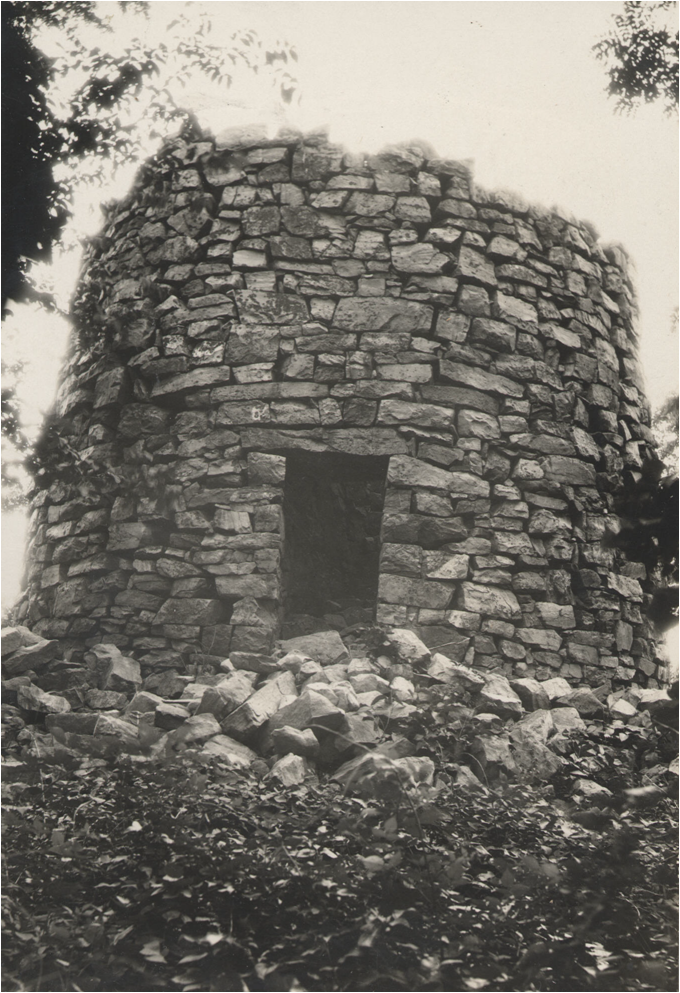
On a clear July morning, Independence Day to be exact, citizens of Boonsboro, Maryland and other nearby communities gathered in the town square to embark on an endeavor only reserved for those with a means to create. To the rolling of the drum and patriotic music, they marched up the to a rocky knoll where they would build a free-standing stone monument to the one of the founding fathers of the United States, George Washington. Built to a height of 30 feet, half on July 4th and half later in the fall, this stone monument would be the first of its kind completed in honor our first president and ,unlike the monuments of the grand architect's, this one was built by the hands of private citizens who felt it was their duty to do so.

Fast forward to 1861, the monument that these patriotic citizens built had fallen into ruin from neglect and vandalism. And as the monument went, so did the country. The country that George Washington and other revolutionaries had fought to establish had begun destroying itself and the patriotism that had built this monument had turn from a local sense of pride in one's country to a regional hatred for their countrymen.

For the better part of a year, the monument lay in ruin among the quiet countryside of western Maryland. That would all change in September 1862 when Robert E. Lee pushed his Army of Northern Virginia, fresh off a summer of victories, across the Potomac River and into Maryland as part of a massive Confederate offensive in both the Eastern and Western Theatres of the war. Only days after entering Maryland, Confederate forces began marching up the National Pike and crossed South Mountain just a mile from the monument. Some of these Confederates, the division of Major General Daniel H. Hill, would be encamped nearby at Boonsboro and on the 13th, Confederate cavalry is being pushed back from the Catoctin's Mountain gaps and Confederate infantry support is moving up to hold the vital gap Turner's Gap on South Mountain. The stage for the Battle of South Mountain had been set.

Throughout the next day, tides of men and the rain of hot lead and shrapnel poured across the mountainside, first at Fox's Gap, then Frostown, Turner's, and eventually Crampton's Gap near Burkittsville. The fight that would have the most impact on the monument would occur just below at the Frostown Gap where the Pennsylvania Reserves would do battle with the tenacious Alabamian's of Robert Rodes' brigade. When Confederate reinforcements under James Longstreet arrived, a most peculiar incident occurred involving the monument. Confederate artillery commander E. Porter Alexander recalled:

"I was riding with Gen. Lee when we came within a mile or two of the fight & some one 
discovered a small party of people on what seemed to be a sort old tower on the mountain
about a mile north of the pass. There were some indications that it might be a signal party of 
the enemy sending messages of our approach,&, itching to have some personal part in a fight,
I suggested to Gen. Lee that I might take a few men and go recapture it. He approved & had 
eight men sent with me from some brigade, I forgot whose. I got in cover of some woods &
then struck up the mountain side &, after a hard, hot climb, at last got up & around the
tower (which seemed to have been built originally for a windmill) before the party on it
knew of my approach. But they were plainly all natives of the vicinity attracted by the firing & 
up here to see the battle. I quite disgusted at the peaceful character of my capture & left
them seeing that the position gave no valuable view of the enemy's ground..."

View from monument. Antietam Battlefield is to the left. 
Reminiscent of US congressmen and other dignitaries following the Union Army to the battlefield at Bull Run, these endeavoring citizens of possibly Zittlestown and Boonsboro had climbed up to the monument to watch the coming battle. With night falling over the battlefield, the monument had witnessed the first great battle of Northern soil. The following day, with Confederate infantry pulling out of the area, Union signal corpsmen were sent to the monument to establish a signal station. This was an excellent position as the movement of the Confederates towards the town of Sharpsburg was easily visible. This is pointed out in the official report of Major Albert J. Myer, the chief signal officer for the Union Army, "From this point, the forces of the enemy were visible near Sharpsburg and thence to Shepherdstown. The line of battle beyond Antietam, then just beginning to form, was seen and a full report of this . . . sent to General McClellan."

Signal station similar to the one that would be constructed around the monument.
Following the 1862 Maryland Campaign, the signal station at the monument was broken down as the armies moved back into Virginia. The monument would again be utilized during the 1863 Gettysburg Campaign when another signal station was erected atop its ruins to observe the movements of the Confederate Army during its retreat. The station was established on July 9th and immediately began reporting on troop movements and strengths. The station reported on the construction of earthworks near Hagerstown and the fighting that took place outside of Funkstown on July 10th. It remained in use until after Lee pulled his army back across the Potomac. The following year, in 1864, the monument again witnessed a Confederate invasion when Jubal Early took the 2nd Corps of the Army of Northern Virginia on an invasion that reached the gates of Washington, D.C. Following this final invasion, the monument would sink back into the quiet country side. 

Restored monument 1880's.
Following the war, the monument was , again, left to neglect and vandals. The monument was not forgotten however. In the late 1870's, the Independent Order of Odd Fellows of Boonsboro funded and sponsored a preservation drive to restore the monument to it's former glory. Work was officially begun in 1882. The monument was deconstructed and built in the exact manner as the original builders did, using free-standing stone. To help "reinforce" the structure, the Odd Fellows had the outside of the monument stuccoed to help prevent any destructive forces from the exterior into the openings between the stones and weakening the interior. The monument was rebuilt to its original height of 30 feet, a road was cut to the monument to allow for easier access, and a steel observation platform was added. This platform added additional weight to the structure and increased its height by about 15 feet (as seen in photo at left).  The monument was re-dedicated on August 18, 1882 before a crowd of 3,000 people, including the governor of Maryland.


 Despite the best efforts of this preservation work, the monument would, again, become neglected and open to vandalism. Weather also took a toll. The steel observation deck was struck by lightning and created a crack down the side of the monument. As a result, the steel structure had to be removed. The stucco began to wear down, weakening the structure even more and as a result, the stones crumbled to the ground. It would remain in this condition for the better part of the next 30 years. 

Front view of monument 1910's
The next effort to restore the monument began in 1916. The Washington County Historical Society, lead by President and state Senator Harvey S. Bomberger, hatched plans to purchase the monument and the one acre of land surrounding it. To help build interest and show importance in the restoration of this monument, Bomberger published an article in The Patriotic Marylander entitled "Maryland's Mountain top monument to Washington" detailing the history of the monument and putting forth his justification for restoring the monument. It can be read here.  Bomberger's efforts caught the eye of the Daughters of the American Revolution and to help bolster more support for the monument, Isabel S. Mason wrote a poem dedicated to the monument entitled, "The First Washington Monument." In its entirety:
Of old thou stood, a watcher lone,
Upon the silent height;
Strong as the Heart of Valley Forge,
That watched in frozen night.
For in thee glowed the pulse that timed,
The march of Freedom's feet;
Fed by the flood of hero blood,
It ne'er shall cease to beat.

The hands, within whose sturdy veins
The patriot thrill coursed free;
Raised up thy sentinel form to him
Who wrought for liberty. 
Those hands are stilled, but, oh, the throb
Hath never ceased to rest;
It vibrates down the path of Time,
And echoes in each breast.

Though shattered once by storm and age,
Yet nature wove thee round,
A flowery, fragrant memory,
Embraced thee from the ground.
The fair, wild blossoms kissed thy form,
The birds sang o'er thy stone;
The star's in nights emblazoned flag
Kept watch with thee alone.

And now, once more thy form shall stand,
Grim Veteran of the past;
Like Liberty, though crushed to earth,
It must arise at last.
From when the thrill of grateful love,
Shall o'er us cease to steal;
'Twill be because our Soul is dead, 
And hearts have ceased to fell.

       Reportedly, Dynamite had been placed in this crack at one point.
This poem was also published in The Patriotic Marylander as well as local newspapers. With the local effort on track, the preservation effort was taken to the national level. At the behest of their constituents, a Maryland Congressman appealed for a $2,500 appropriation to assist in the restoration of the monument. The historical society managed to purchase the monument and land in 1920 but its preservation efforts became stalled. Following collapse of the stock market and the onset of the Great Depression, the historical society could not afford to preserve the monument on its own. With the help of Bomberger, using his position as a state senator, the Washington County Historical Society deeded the monument over to the State of Maryland in the early 1930's. With this move, the restoration of the monument could become a reality. 

The monument created a great opportunity for the Civilian Conservation Corps (CCC) to restore the monument and provide a park for the public to use. The CCC had been busy restoring the walls of Fort Frederick outside Big Pool, Maryland. As a result, several men from this camp were taken up to the monument and it was completely deconstructed. Plans were drawn up and called for the monument to be completely rebuilt from the ground up using all the modern tools to built it. Instead of building it of free-standing stone, the CCC would place mortar between the stones to keep the stones in place making the monument even more structurally sound then previous efforts. It would take nearly 2 years for the monument to be rebuilt but once it was finished, it was built to last.

Rebuilding the monument.

For 184 years, the monument has stood as a testament to the patriotic feelings that the everyday citizen has for their country. It also stands a simple monument built to the memory of George Washington and all the revolutionaries who sacrificed all so that freedom could be achieved. It survived the countries greatest trial despite already being in ruins. Today the monument serves as the focal point of Washington Monument State Park which is also the home of South Mountain State Battlefield.


Thursday, November 10, 2011

Captain James Bondurant and the Jeff Davis Artillery

Providing the only immediate artillery support to the Confederate defenders at Fox's Gap, Captain James Bondurant and his Alabamians of the Jeff Davis Artillery helped keep back the Union onslaught despite the Confederate defenders being stretched thin.

The Jeff Davis artillery was organized in Selma, Alabama in May 1861 under the command of Captain James T. Montgomery and was sent east where it was assigned to the brigade of Jubal Early at Manassas. James Bondurant would rise to command of the regiment following the resignation of Captain Montgomery and his election as the new Captain of the Battery.

Captain Bondurant
James William Bondurant was born in Buckingham County, Virginia in 1835. Shortly before the war, his family migrated to Alabama. When war broke out, he enlisted as a sergeant in Montgomery's JEff Davis Artillery. He would eventually rise to command of the battery and lead it through some of its most horrific fights. Bondurant would lead the battery in fighting at Seven Pines, Mechanicsville, and Gaines Mill suffering numerous dead and wounded.

Following the Confederate "victories" on the Peninsula, Bondurant's battery remained in Richmond with the division of Daniel Harvey Hill as the remainder of the Army of Northern Virginia moved north to deal with the Army of Virginia under John Pope. Pope was ultimately defeated at the Battle of Second Manassas/Bull Run setting the stage for the Confederate invasion of Maryland.

Bondurant moved with his battery northward to join up with the Confederate forces massing at Leesburg in preparation for the inevitable advance across the Potomac. The battery crossed the Potomac with the rest of D.H. Hill's artillery on September 4, 1862. The unit would enter Frederick on 6th and remain here until the 10th. On the 10th, the Confederates moved out of Frederick in an effort to capture the vital transportation hub of Hagerstown and to capture the Union garrison at Harpers Ferry that was sitting just miles from the proposed supply and communication route for the Confederate advance into Pennsylvania. Attached to Samuel Garland's brigade of Hill's Division, Bondurant's battery went into camp near Beaver Creek outside Boonsboro, MD on the 13th to await developments. The wait would not be long. Word reached General Hill at Boonsboro, that Union infantry and cavalry were pushing back Confederate troopers holding Braddock's Gap on the National Pike. Hill ordered Alfred Colquitt's brigade to take up defensive positions at Turner's Gap and Garland's brigade to move in the direction of South Mountain in close support.

On the morning of the 14th, Hill was on a personal reconnaissance down what was called the Wood's Road by locals in the direction of Fox's Gap when he heard noises to his front. Believing this was the Union Army crossing the mountain, Hill quickly turned to go back to his Turner's Gap when he came under artillery fire. Bolster in his belief he was being outflanked, Hill returned to his headquarters at Turner's Gap to find Garland and Bondurant's battery coming up the mountain. He immediately ordered them to Fox's Gap and to hold at all cost. Arriving at Fox's Gap, Garland found that he noises were in fact the 5th Virginia Cavalry who were posted there by J.E.B. Stuart. Quickly, Garland deployed his line and Bondurant was deployed in a field to the south of the Daniel Wise Cabin with the support of the 90 men of the 12th North Carolina under Captain Shugan Snow.

Just before 9 A.M., the men of Bondurant's battery and Bondurant himself could vaguely see the movement of blue shadows in the woods to their immediate front. Bondurant's men and guns were fully exposed in the field where they were deployed and their only escape route was to their immediate rear along a mountain road leading back to Fox's Gap. After some time, several Union soldiers appeared in a valley that had allowed the Union men to advance uncomfortably close to the battery and Confederate infantry, who had their arms stacked believing that action was not soon at hand. Bondurant requested the skirmishers be sent out to ascertain what was going on in the woods to his front. The infantry commanders in immediate support of the battery refused to oblige Bondurant's request because orders had not come down from General Garland.

Rebuffed not once, but twice, Bondurant decided he was to meet coming Union attack himself. Almost immediately, a Union line appeared with in yards of the batteries right flank and began to quickly advance against the unsupported battery. A Union volley cut the silence and the Battle of South Mountain had begun. Amazingly, no men from Bondurant's battery fell during this initial volley. Garland, hearing the firing, quickly appeared and ordered the the infantry to advance to meet this line and ordered Bondurant to commence firing. Bondurant, with the situation in hand, ordered his battery to change front to the right to meet this Union threat. Unfortunately, his battery could only fire one gun at a time from this position and he ordered each gun to fire once then withdraw. Firing point-blank into the Union line throwing it into confusion. Each gun successfully got one round off before withdrawing to their waiting limbers and caissons in the road. Bondurant withdrew his battery all the way back to a position near the Daniel Wise cabin before re-deploying and opening up a steady barrage against the Union forces. Bondurant's men would hold this position for the better part of the morning and would witness the disintegration of General Garland's brigade and the removal of General Garland's limp body from the field.

Just before 11, a portion of General George B. Anderson's brigade, under Colonel C.C. Tew had arrived on the field and with the help on Bondurant's battery, they held back the Union assault and managed to maintain a slim foothold on Fox's Gap and the vital intersection.  During the course of the late morning action, a Union battery began raining shells down on Bondurant's position. To protect his men and guns, Bondurant was forced to move a section of his battery to the crest of Wise's North Field just east of the Woods Road. 

During the mid-day lull of the battlefield, Asa Cook's Massachusett's battery deployed a few hundred yards from the summit at Fox's Gap and opened fire on Confederate batteries to the right at Turner's Gap. Unknown to them, less then two hundred yards away, Captain Bondurant had his men quietly loading canister. After the Union battery fired a few rounds, Bondurant unleashed his guns on the surprised Union artillerymen. Fearing for their lives, some of the Union artillerist ran from their guns and others sought out cover wherever they could find any. Bondurant's battery had a devastating effect on the Union battery killing and wounding several men and horses. The batteries fire also stirred up a panic within the ranks of General Orlando Willcox's division that was deploying astride the Old Sharpsburg Road. Taken in the flank by the shell and canister of the Confederate, the infantrymen panicked before eventually sorting themselves out and seeking cover from the artillery fire.

This devastating fire from Bondurant's guns made them a target for Union commanders. Orders quickly came from General Jesse Reno, commanding the 9th Corps, to General Willcox to "silence the the enemy's battery at all cost." Just as the Union infantry began it's advance, Confederate infantry from General Thomas Drayton advanced out of the Old Sharpsburg Road and a bloody standoff ensued. During this savage fighting, the section of Bondurant's guns that had remained at the Daniel Wise Cabin withdrew and rejoined the section in Wise's North Field. The climactic moment of the battle for Fox's Gap had arrived.

From the North Field, Bondurant's battery continued supporting Drayton's infantry to the best of their ability. Bondurant's men, in position in the northwestern corner of Wise's North Field, rained shot and shell down on the Union infantry pressing Drayton's men. From their left, a new threat emerged from the woods in the form of the 17th Michigan Infantry that fell on the flank and rear of Drayton's brigade. Their primary mission was to silence Bondurant's guns but their advantage over the Confederate infantry quickly became the more relevant attack. Bondurant, seeing that the battle was out of control for the Confederates, unleashed canister on the Michigan men in a vain attempt to halt their advance but the tactic was to no avail. Bondurant was forced to withdraw from the battlefield and Drayton's men were left without artillery support. Fortunately for the Confederates, John Bell Hood's division arrived to shore up the sagging Confederate hold on Fox's Gap.

Bondurant pulled his men back down the mountain to the reserve trains to replenish their ammunition but upon arriving, they found that the armies artillery ammunition had been depleted drastically due to the severe fighting of the day. Bondurant ordered his men to get what they could and after doing so, they greatfully settled down for some much needed rest. The Jeff Davis Artillery had been in action for the better part of 10 hours on September 14th and amazingly, not a single man was lost despite the battery being in close proximity to the main battlelines. The battery would go on to fight and ,suffer heavily, at Antietam, Fredericksburg, Chancellorsville, Gettysburg, the 1864 Overland Campaign, and the Siege of Petersburg. The battery would surrender at Appomattox Courthouse in April 1862 only able to muster 1 officer and 26 men. 


Monday, October 3, 2011

". . . the severe musketry of the enemy was returned with the cool deliberation and steady aim of experienced marksmen."

The following is the official report of Lieutenant Colonel Alexander D. Adams, the commanding officer of the 27th New York regiment during the fighting at Crampton's Gap.

Hdqrs, 27th N.Y. Vols- In the Field, Near
Williamsport, Md., Sept. 23, 1862.
Lieutenant:- I have the honor to submit the following report of the part taken by this regiment in the action of Crampton's Pass, September 14, 1862:

On leaving Jefferson, the Ninety-Sixth Pennsylvania was sent out in advance, as skirmishers; and soon after, the Sixteenth New York was assigned to support a battery ; so that the Twenty- seventh had the advance on approaching the pass. The presence  of the enemy having been discovered, the brigade was drawn into a ravine, in column by battalion, to avoid his artillery, and to prepare for storming the gap. Shortly after, the Ninty-sixth Pennsylvania having been recalled and placed in the column, the brigade moved, under cover as far as practicable, toward the pass, and at 3:30 the Twenty-seventh --still leading the column-- was ordered by Colonel Barlett, commanding brigade, to deploy as skirmishers, advance on the pass, and develop the enemy's position, --the center of the line, which was at least a mile long, being directed to the right of the pass. Almost as soon as the deployment was completed, and the flank companies had been thrown forward a little, bringing the line into the form of an arc, the skirmishers became briskly engaged, simultaneously on the right and left, with superior force of the enemy, posted at the base of the mountain, behind stone fences and houses.

The firing at once became general along the whole line, and was very rapid, and at close range. In ten or fifteen minutes the first line of attack of this brigade had advanced to the left of the center of the line of skirmishers, and opened a fierce fire on the enemy in the woods in front. After considerable interval, the musketry continuing fiercely, the Second Brigade, in column, Gen. Newton's, having been brought up to support the attack, and the skirmishers, as well as the first line of Col. Bartlett's brigade, having expended their ammunition, the colonel commanding directed  that the skirmishers should retire and rally on the center, for the purpose of re-forming the regiment. This was done in good order, though, owing to the extent of the line, it necessarily occupied some time, --the charge which carried the pass being made when but three or four companies had formed. As soon as the flank companies had come in, the regiment was placed in position previously indicated by Gen. Barlett, where it remained until the next morning. The action had terminated in the total rout of the enemy before this position was taken up. 

The conduct of this command, during the entire engagement, was most admirable. Though exposed to the fire of the enemy's artillery, while advancing over the open fields, there was no faltering or hesitation, and the severe musketry of the enemy was returned with the cool deliberation and steady aim of experienced marksmen. 

It is reported by prisoners, that the manner and steadiness of the advanced convinced the enemy that he had not raw troops to deal with. The great extent of the line rendered the transmission of orders difficult, and I am greatly indebted  to Major Bodine and Adjutant Thompson, for the aid which maintained the proper disposition and unbroken continuity of the line. All  the officers, save one, maintained and added to the reputation they had won in the previous history of the Twenty-seventh. 

It would not be proper to conclude this report without mentioning the efficient conduct of Surgeon Barnes, of this regiment, whose hospital was established nearest the field, and who was the first surgeon to visit the wounded, collected in the houses at the foot of the mountain, and on the field after the action was over. 

The casualties are: 6 killed and 27 wounded; among the latter at Lieuts. Seely and Christman, and Color-bearer Sergt. McMahon.
            I am, sir, very respectfully,
                                Alexander D. Adams.
                                      Lieutenant Colonel, Commanding. 


Source:

1. Fairchild, Charles Bryant. History of the 27th regiment N.Y. vols., being a record of its more than two years of service in the War for the Union, from May 21st, 1861, to May 31st, 1863. With a complete roster and short sketches of Commanding officers. Also, a record of experience and suffering of some of the comrades in Libby and other Rebel prisons. Compiled by C. B. Fairchild, of Company "D." Published under the direction of the following committee: Gen. H. W. Slocum [and] Capt. C. A. Wells. Binghamton, Carl & Matthews, printers [1888], 106-107.


Thursday, September 29, 2011

The Union Regiment: 27th New York Volunteer Infantry

National Flag of Company H, 27th New York
On September 14th, 1862, the 27th New York found itself in the thick of the fighting during the 6th Corps assault on Crampton's Gap outside of Burkittsville, Maryland. The regiment would be deployed as skirmishers and when the order came to charge, they were among the Union wave that swept up the mountain in the climactic twilight assault. The regiment would suffer 6 men killed and 27 wounded.


What would become the 27th New York was accepted into state service on May 21,1861 with  companies that were formed in late April and early May and were recruited as follows (location,recruiter):

Company A: White Plains, Captain Joseph J. Chambers
Company B:  Lyons, Captain Alexander D. Adams
Company C: Binghamton, Captain Joseph J. Bartlett
Company D: Binghamton, Captain Hiram C. Rogers
Company E: Rochester, Captain George G. Wanzer
Company F: Binghamton, Captain Peter Jay
Company G: Lima, Captain James Perkins
Company H: Mount Norris, Captain Charles E. Martin
Company I: Angelica, Captain Curtis C. Gardiner
Company K: Albion, Captain Henry L. Achilles, Jr.

Once these various companies were gathered at Elmira, New York, and election of officers was held and the elected officers were as follows:

Colonel: Henry W. Slocum
Lt. Colonel: Joseph J. Chambers
Major: Joseph J. Bartlett

With these elections, the State Military Board verified the elections and designated the new regiment the 27th New York Volunteer Infantry. The new recruits took the nickname "Union Regiment" because they had been recruited from various parts of the state and had by their own choice, regimented themselves with each other. The regiment would only remain in New York until the middle of July when it was ordered to Washington, D. C. where it was assigned to the 1st Brigade, 2nd Division in the Army of Northeastern Virginia and participated in the the First Battle of Bull Run where it was heavily engaged. Colonel Slocum would be wounded and Major Bartlett would take command of the regiment. When the day began going against the Union forces, Bartlett was ordered to retreat and go into line of battle a various points to cover the retreat of the defeat Union army. The regiment lost 130 men killed, wounded, and missing in their first fight.

Following the disaster at Bull Run, like the rest of the Union army around Washington, the 27th drilled and drilled. The army was also reorganized and christened the Army of the Potomac under Major General George McClellan, affectionately known to the men as Lil Mac. The 27th would find themselves in Brigadier General Heintzelman's brigade from August 4 to October 15 when they would become part of the the former commander, Henry Slocum's brigade in William Franklin's division. In the spring of 1862 they would become part of the 2nd brigade, under Slocum, of the 1st Division, 1st Corps of the Army of the Potomac. This assignment would last until May when the division was assigned to the 6th Corps. The regiment would remain in this assignment until May 1863.

When McClellan took his massive Army of the Potomac to the Virginia Peninsula in an attempt to capture Richmond on that front, the 27th New York found itself marching through the feverish land of the Virginia tidewater region. During the advance up the peninsula, the regiment would fight it skirmishes at West Point and near Mechanicsville at various points in May and at the beginning of June. During this campaign, the regiment would find itself in a brigade with the 5th Maine, 16th New York, and 96th Pennsylvania under command of Joseph Bartlett, who had risen to the rank of  colonel. When the Confederate Army, now under Robert E. Lee, lashed out of Richmond attacking McClellan's army in what would become the Seven Days' Battles, the 27th New York found itself in the thick of the fighting. Taking part in the actions at Gaines Mill, Glendale, and Malvern Hill, the regiment suffered heavily losing 162 men and officers in the week long fighting. McClellan would pull his army back to Harrison's Landing where it would lick its wounds and wait for its next call to action.

For the next few weeks, the 27th New York remained on the Peninsula suffering through the head of a Virginia summer. Unknown to these Union men, Robert E. Lee had quietly pulled his army back to Richmond and northward to combat John Pope's Army of Virginia that was ransacking the northern Virginia area. With the main theatre of operations changed, McClellan's massive army was useless on the peninsula and it began its trek back to Washington by water. The 27th left its camp on the peninsula on August 20th marching from Yorktown to Newport News where it arrived on August 21st. The next day the regiment embarked for its trip to Alexandria where it disembarked on August 25th. It was immediately ordered to picket duty. On the 28th, it marched to Fairfax then Centreville. The regiment would not actively participate in the Second Battle of Bull Run but it would assist in covering the retreating army back to Washington. It would go into camp on September 1st at Fort Lyon.

Over the next days, the 27th hunkered down in the defenses of Washington with the remainder of the Union army while upriver at Leesburg, Robert E. Lee decided now was the best time to invade Maryland and between the 4th and 7th of September, Lee's victorious army crossed the Potomac and lurched toward Frederick, Maryland. The 27th would remain at Fort Lyon until the 5th when it was ordered to march towards Washington. Breaking camp late in the evening, the 27th marched across the Long Bridge, through Washington and Georgetown before making camp on Georgetown Heights, a march of 15 miles. The next night the regiment would again march this time only 7 miles. It would then continue its marches passing Sugarloaf Mountain on the 12th where its members saw dead cavalryman from skirmishes fought just a few days earlier. The regiment would march until it arrived at Burkittsville on the morning of September 14th.

Upon arriving, the 96th Pennsylvania was ordered to advance on the town. It a strong skirmish line, the Confederate cavalry that was holding the town was forced back. The 27th along with the rest of Colonel Bartlett's brigade then moved through the town deploying in the fields just east in preperation for the assault on Crampton's. The attack began at about 4 o'clock in the evening and the 27th was deployed as skirmishers. From the history of the 27th:

"We were soon ordered forward, and in heavy marching order, at  double quick, deployed as skirmishers on an open plain, facing the mountain, the centre of the line following the road which crosses the mountain at this place, known as Crampton's Pass. As we advanced, the enemy opened on us  with artillery, stationed half-way up the mountain, and with a heavy volley of musketry from behind trees and rocks, and a stone wall at the foot of the mountain."

The 27th was supported 200 yards to the rear by 5th Maine and 16th New York. With the 27th coming under heavy fire, these two regiments rushed forward and the 27th reformed in line of battle and the fighting began in earnest.

"The skirmishers advanced splendid line till within thirty or forty rods of the wall, when we were ordered to rally, and give place to the line of battle that was coming in close behind us. One squad of the pickets took cover in a barn-yard, behind the sheds and outbuildings, where they kept up a lively and telling fire till the main line came up. Another squad of pickets, not hearing the order to rally, found themselves between the two lines of battle and were obliged to lie down . . . bullets cutting up the ground all around them. Others joined in the main line in the charge on the stone wall. As our men went over the wall, some of the rebels tried to retreat, and others threw down their arms and surrendered. On went our line, up the side of the steep mountain, so steep in many places that the men had to pull themselves up by taking hold of the bushes."

This was the climactic charge that captured Crampton's Gap. After breaking the second line that was forming at the gap itself, the battle was over. The frenzied charge was so successful that hundreds of Confederates were taken prisoner and several battle flags were captured. For its fight, the 27th lost only 33 men killed and wounded. The regiment would be given the gruesome task of burying the dead following this fight. When fighting began around Sharpsburg, the regiment was still on top of the mountain. Hearing the sounds of cannonading in the distance, the regiment began its march towards this new battlefield arriving in Keedysville before marching to the northern sector of the battlefield where it would go into line of battle in the infamous Cornfield. Gratefully, the regiment would not take a major part in the battle as the two foes had beaten themselves to death literally on the ground the New Yorkers occupied. On the 18th, the 27th remained in position awaiting what could possibly be a Confederate counterattack, one that never came. During the day an informal truce was declared so that the dead could be buried. The men of the 27th did their part and several could not eat and became sick because the bodies of those killed had decomposed so rapidly.

Following the repulse of Lee, the 27th marched towards Williamsport on the 20th of September to combat a suspected river crossing. No crossing was attempted and the regiment marched to Bakersville where it would go into camp until November when Ambrose Burnside replaced McClellan has the commander of the Army of the Potomac. Under Burnside, the 27th would be take part in the Fredericksburg Campaign but it would luckily find itself in reserve during the disastrous assaults on Marye's Heights. It's next military action would take place during the assault on Marye's Heights during the 2nd Battle of Fredericksburg where it would lose 19 men killed and wounded. With this final battle, the regiment would find itself returning to New York. Arriving in Elmira, the regiment was discharged from service on May 31, 1863.

Sources:


1. G.B. Fairchild. History of the 27th Regiment N.Y. Vols.: Being a ecord of its ore than two years of Service in the War for the Union, From May 21st, 1861 to May 31st, 1863. Binghamton, NY: Carl &Matthews printers.

2. 27th New York Infantry at New York State Military Museum

3. Flag Image found at NYSMM


Wednesday, September 14, 2011

149th Anniversary of the Battle of South Mountain

Today mark's the 149th anniversary of the clash that took place on the slopes of South Mountain. I take this time to ask you, the reader, to remember those that fell at this battle and remember that each side fought for the cause that they believed in, whether it be right or wrong. If you would like to read a roll of those that fell during the battle, please click the casualties tab under the Label's section of this page. I regret that I have only been able to list some of those that fell during this eventful day and I plan on adding more in the future.

Also, if one would like to read about the fighting that took place, the links to the articles are below.

Crampton's Gap: Twilight assault

Bathed in Blood: The Afternoon fight at Fox's Gap

"Hell is empty and all the devils are here": the morning fight at Fox's Gap

Birth of the Iron brigade: Turner's Gap

Pennsylvania Reserves capture the Frostown Gap

You can also click the various labels on the right of the screen to learn more about the battle as well. Thanks again for reading my blog and I hope that you get a chance to visit the battlefield up on the mountain. 


Tuesday, September 13, 2011

"Should the truth ever be known, the battle of South Mountain . . . will be regarded as one of the most remarkable and creditable of the war."

 The following is the portion of Brigadier General Daniel Harvey Hill's official report of his division's involvement in the Maryland Campaign that deals with the fighting at South Mountain. Hill would be ordered by General Lee to protect the mountain gaps near Boonsboro to protect the main body of the army as it marched to Hagerstown as well as the reserve artillery train which would be encamped along a ridgeline just beyond Beaver Creek, just to the west of Boonsboro. Hill would also be ordered to keep an eye on roads leading south in an effort to keep any Union troops from escaping from Harper's Ferry. Hill would set up his headquarters in the Mountain House, the present day South Mountain Inn, where he would direct the defenses of the gaps at Frostown, Turner's and Fox's. His division would be the first engaged and until the arrival of Longstreet's command in the early afternoon, he would be clinging to the rebel foothold on the mountain.

On the 13th, I was ordered by General Lee to dispose of my troops so as to prevent the escape of the Yankees from Harper's Ferry, then besieged, and also to guard the pass in the Blue Ridge near Boons-borough. Major-General Stuart reported to me that two brigades only of the Yankees were pursuing us, and that one brigade would be sufficient to hold the pass. I, however, sent the brigades of Garland and Colquitt, and ordered my other three brigades up to the neighborhood of Boonsborough. 

An examination of the pass, very early on the morning of the 14th, satisfied me that it could only be held by a large force, and was wholly indefensible by a small one. I accordingly ordered up Anderson's brigade. A regiment of Ripley's brigade was sent to hold another pass, some 3 miles distant, on our left. I felt reluctant to order up Ripley and Rodes from the important positions they were holding until something definite was known of the strength and design of the Yankees. About 7 o'clock they opened a fire upon our right, and pushed forward a large force through the dense woods to gain a practicable road to our rear. Garland's brigade was sent in to meet this overwhelming force, and succeeded in checking it and securing the road from any further attack that day. This brilliant service, however, cost us the life of that pure, gallant, and accomplished Christian soldier, General Garland, who had no superiors and few equals in the service. The Yankees on their side lost General Reno, a renegade Virginian, who was killed by a happy shot from the Twenty-third North Carolina. Garland's brigade was badly demoralized by his fall and the rough handling it had received, and, had the Yankees pressed vigorously forward, the road might have been gained. Providentially, they were ignorant of their success or themselves too much damaged to advance. The Twentieth North Carolina of this brigade, under Colonel Iverson, had attacked a Yankee battery, killed all the horses, and driven off the cannoneers. This battery was used no more that day by the Yankees. Anderson's brigade arrived in time to take the place of the much-demoralized troops of Garland. There were two mountain roads practicable for artillery on the right of the main turnpike. The defense of the farther one had cost Garland his life. 

It was now intrusted to Colonel [T. L.] Rosser, of the cavalry, who had reported to me, and who had artillery and dismounted sharpshooters. General Anderson was intrusted with the care of the nearest and best road. Bondurant's battery was sent to aid him in its defense. The brigade of Colquitt was disposed on each side of the turnpike, and that: with Lane's battery, was judged adequate to the task. There was, however, a solitary peak on the left, which, if gained by the Yankees, would give them control of the ridge commanding the turnpike. The possession of this peak was, therefore, everything to the Yankees, but they seemed slow to perceive it. I had a large number of guns from Cutts' artillery placed upon the hill on the left of the turnpike, to sweep the approaches to this peak. From the position selected, there was a full view of the country for miles around, but the mountain was so steep that ascending columns were but little exposed to artillery fire. The artillerists of [A. S.] Cutts' battalion behaved gallantly, but their firing was the worst I ever witnessed. Rodes and Ripley came up soon after Anderson. Rodes was sent to the left, to seize the peak already mentioned, and Ripley was sent to the right to support Anderson. Several attempts had been made previous to this, by the Yankees, to force a passage through the woods on the right of and near the turnpike, but these were repulsed by the Sixth and Twenty-seventh Georgia and Thirteenth Alabama, of Colquitt's brigade.

It was now past noon, and the Yankees had been checked for more than five hours; but it was evident that they were in large force on both sides of the road, and the Signal Corps reported heavy masses at the foot of the mountain. In answer to a dispatch from General Longstreet, I urged him to hurry forward troops to my assistance. General Drayton and Col. G. T. Anderson came up, I think, about 3 o'clock, with 1,900 men, and I felt anxious to beat the force on my right before the Yankees made their grand attack, which I feared would be on our left. Anderson, Ripley, and Drayton were called together, and I directed them to follow a path until they came in contact with Rosser, when they should change their flank, march into line of battle, and sweep the woods before them. To facilitate their movements, I brought up a battery and made it shell the woods in various directions. Anderson soon became partially and Drayton hotly engaged, but Ripley did not draw trigger; why, I do not know. The Fourth North Carolina (Anderson's brigade) attempted to carry a Yankee battery, but failed. Three Yankee brigades moved up, in beautiful order, against Drayton, and his men were soon beaten and went streaming to the rear. Rosser, Anderson, and Ripley still held their ground, and the Yankees could not gain our rear.

Affairs were now very serious on our left. A division of Yankees was advancing in handsome style against Rodes. I had every possible gun turned upon the Yankee columns, but, owing to the steepness of the acclivity and the bad handling of the guns, but little harm was done to the "restorers of the Union." Rodes handled his little brigade in a most admirable and gallant manner, fighting, for hours, vastly superior odds, and maintaining the key-points of the position until darkness rendered a further advance of the Yankees impossible. Had he fought with less obstinacy, a practicable artillery road to the rear would have been gained on our left and the line of retreat cut off.
Colonel[J. B.] Gordon, the Christain hero, excelled his former deeds at Seven Pines and in the battles around Richmond. Our language is not capable of expressing a higher compliment.
General Rodes says:
The men and officers generally behaved well, but Colonel Gordon, Sixth Alabama; Major [E. L.] Hobson, Fifth Alabama, and Colonel [C. A.] Battle, Third Alabama, deserve especial mention for admirable conduct during the whole fight. We did not drive the enemy back or whip him, but with 1,200 men we held his whole division at bay for four hours and a half without assistance from any one, losing in that time not more than half a mile of ground.
He estimates his loss at 422 out of 1,200 taken into action, but thinks that he inflicted a three-fold heavier loss on the Yankees Colonel [B. B.] Gayle, of the Twelfth Alabama, was killed, and Colonel [E. A.] O'Neal, Twenty sixth Alabama, and Lieutenant-Colonel [S. B.] Pickens, of the Twelfth, severely wounded. 

Major-General Longstreet came up about 4 o'clock with the commands of Brig. Gens. N. G. Evans and D. R. Jones. I had now become familiar with the ground, and knew all the vital points, and, had these troops reported to me, the result might have been different. As it was, they took wrong positions, and, in their exhausted condition after a long march, they were broken and scattered. Our whole left was now fairly exposed, and the Yankees had but to push down to seize the turnpike. It was now dark, however, and they feared to advance. All the available troops were collected behind a stone wall, to resist an approach upon the turnpike from the left. Encouraged by their successes in that direction, the Yankees thought that it would be an easy matter to move directly up the turnpike; but they were soon undeceived. They were heroically met and bloodily repulsed by the Twenty-third and Twenty-eighth Georgia Regiments, of Colquitt's brigade. The fight lasted for more than an hour after night, but gradually subsided as the Yankees retired. General Hood, who had gone in on the right with his two noble brigades, pushed forward his skirmishers and drove back the Yankees.
We retreated that night to Sharpsburg, having accomplished all that was required--the delay of the Yankee army until Harper's Ferry could not be relieved. 

Should the truth ever be known, the battle of South Mountain, as far as my division was concerned, will be regarded as one of the most remarkable and creditable of the war. The division had marched all the way from Richmond, and the straggling had been enormous in consequence of heavy marches, deficient commissariat, want of shoes, and inefficient officers. Owing to these combined causes, the division numbered less than 5,000 men the morning of September 14, and had five roads to guard, extending over a space of as many miles. This small force successfully resisted, without support, for eight hours, the whole Yankee army, and, when its supports were beaten; still held the roads, so that our retreat was effected without the loss of a gun, a wagon, or an ambulance. Rodes' brigade had immortalized itself; Colquitt's had fought well, and the two regiments most closely pressed (Twenty-third and Twenty-eighth Georgia) had repulsed the foe. Garland's brigade had behaved nobly, until demoralized by the fall of its gallant leader, and being outflanked by the Yankees. Anderson's brigade had shown its wonted gallantry. Ripley's brigade, for some cause, had not been engaged, and was used with Hood's two brigades to cover the retreat. Had Longstreet's division been with mine at daylight in the morning, the Yankees would have been disastrously repulsed; but they had gained important positions before the arrival of re-enforcements. These additional troops came up, after a long, hurried, and exhausting march, to defend localities of which they were ignorant, and to fight a foe flushed with partial success, and already holding key-points to further advance. Had our forces never been separated, the battle of Sharpsburg never would have been fought, and the Yankees would not have even the shadow of consolation for the loss of Harper's Ferry

Source:

The War of the Rebellion: A Compilation of of the records of the Union and Confederate Armies; Series 1, Volume 19 (part 1), pgs. 1019-1022.