South Mountain by Rick Reeve

South Mountain by Rick Reeve
South Mountain by Rick Reeve depicting the wounding of General Garland

Tuesday, December 20, 2011

"Soon after we halted, the enemy advanced upon us in overwhelming numbers."

The following is the official report written by Colonel Fitz William McMaster. Colonel McMaster commanded the 17th South Carolina Infantry in Brigadier General Nathan Evan's brigade. His regiment would go into the battle on the mountain spur just north and east of the National Pike. During its fight, McMaster's regiment would suffer a casualty rate of 43%. The report includes reports on the Battles of Malvern Hill, Rappahannock Station, and Second Manassas which have been omitted but can be seen in Volume 12, part 2 starting on page 632 of the Official Records.


Camp near Winchester, Virginia
October 20, 1862

Sir: In obedience to your orders to report the action of the Seventeenth Regiment South Carolina Volunteers, in the battles in which it has been engaged since it came to Virginia, I have the honor to report:

Boonsborough

Sunday evening, September 14, about 4 o'clock, after a most fatiguing march, under which some of our men broke down, the brigade took position on the slope of a mountain on the east side of the turnpike. Soon after we halted , the enemy advanced upon us in overwhelming numbers. After fighting for about an hour, and after the other regiments of the brigade had broken and retired, and we were being flanked by the enemy, I ordered my regiments to retire, firing. After we began the retreat,  we were so unfortunate to lose our gallant lieutenant colonel (R.S. Means), who was shot through the thigh. I detailed four men to bear him off, but he magnanimously refused to allow them to make the effort, as the enemy was in short distance of him and still advancing. 

I succeeded in forming a new line of battle, on a knoll about 300 yards in rear of the first line, but was soon flanked by the enemy and compelled to retire. I brought off with men 36 men, rank and file, in order. I was soon ordered by Major Sorrel to form on the left of General Jenkins' brigade; but before we were able to do so night overtook us, and, under the order of General Evans, we retired to the turnpike. 

In this battle we had engaged - - -
officers . . . . . . . . . . . . . . . . . . . . . . . . . . . . . . 10
rank and file and ambulance corps . . . . . . . 131

       total. . . . . . . . . . . . . . . . . . . . . . . . . . . . 141

 [The following were casualties]

number killed. . . . . . . . . . . . . . . . . . . . . . . .   7
number of severely wounded . . . . . . . . . . . .13
number of slightly wounded . . . . . . . . . . . . 24
number of missing . . . . . . . . . . . . . . . . . . .  17
     
      total . . . . . . . . . . . . . . . . . . . . . . . . . . .  61


 Source:

 The War of the Rebellion: A Compilation of of the records of the Union and Confederate Armies; Series 1, Volume 19 (part 1), pg. 945. 

Monday, December 19, 2011

Lieutenant James W. Schenck, 22nd New York Infantry

This is a photo of Lieutenant James W. Schenck who was serving as the quartermaster of the 22nd New York during the Maryland Campaign. He would enlist in as a private in a company of the 93rd New York before he was discharged for promotion to the staff of the 22nd New York in September 1961.

Lieutenant Schenck was commended by his brigade commander, Colonel Walter Phelps, Jr., for his role during the brigades fight at South Mountain. Acting as quartermaster, Lieutenant Schenck job was not to take part in any battles but to ensure that the regiment was fully equipped and supplied when the battle started. At South Mountain, he would be acting as one of two aides to Colonel Phelps and as a result he would be required to carry orders to the brigades various commanders under fire.

Colonel Phelp's commendation: 

"I cannot allow the conduct of Lieutenant Cranford, Fourteenth New York State Militia, and Lieutenant Schenck, Twenty-second New York Volunteers, aides to myself, to pass by unnoticed. I was often obliged to send them, through a galling fire, to different parts of the field with orders. Their conduct on this occasion was most gallant, and all that I could have desired. It was more striking that their line of duty not require their presence on the field at that time, the former being acting commissary of subsistence, and the latter regimental quartermaster."

Sources:


1. New York State Military Museum. Photo, Lieutenant Schenck

2.The War of the Rebellion: A Compilation of of the records of the Union and Confederate Armies; Series 1, Volume 19 (part 1), pg. 232.  


Monday, December 12, 2011

"The sight of the field after the battle is more horrible then the battle itself..."

The following letter was written by John M. Lovejoy. He enlisted in the army in August 1862 in Company G of the 121st New York Volunteer Infantry. He was only 19 years old and his first taste of battle came during the fight at Crampton's Gap. Fortunately, Lovejoy's regiment remained in reserve during the battle but, Lovejoy writes about what he witnessed as the 6th Corps attacked up the slopes of the mountain. He also writes, rather graphically, about what he witnessed as his regiment moved up to the Crampton's Gap to occupy the gap and bury the dead. Following the battle, he would serve as an orderly tending to wounded of both sides in Burkittsville. He would rise to the rank of Corporal before being mustered out with his company in June 1865. 


Headquarters of the 121 Regt. NY Vol.
Battlefield near Burkittsville, Maryland


My dear Cousins and friends,

It is with strange feeling but yet a feeling of gratitude that I now attempt to write to you about one half hour ago, the 2nd lieutenant came in with letters for the company. On having heart leaped with joy when I heard my name called now I must write in short all that will interest you. One week ago yesterday we took up the lines of march to join the division. We joined Slocum's. We belong to [Franchot's] Reg., Bartlett's Brigade, Slocum's Division, Franklin's Corps. Yesterday morning (Sunday), we were near at three o'clock. At five, we were in line for march. We had not marched more than 2 1/2 miles when the booming of artillery told us that we were engaging the enemy about Harpers Ferry. We marched on til noon when we halted in a field in front of the Village of Jefferson. About [two] hours had passed in sight of artillery firing when were were ordered forward. We moved across the fields instead of roads and cornfields and ridges when we were halted in a ravine between the mountain and our batterys. Our men fired a gun to draw the [attention] of the rebels while were were moving down the gulf the rebels returned the fire. The shells falling over our heads about fifteen feet. I must confess that I dazed when the shells passed whistling like fury. When we got in the ravine, we found about five thousand men drawn up in line ready to march at a moments warning. About three o'clock, all the forces except out reg. were called upon to march to the field. We were held in reserve. Our boys marched boldly across the plain under such a volley of grape, canister, and shell. The hill the rebels held was as steep as that south of you house. The rebels had their batteries planted in a road out through the wood about half way up the hill. Our forces marched up to the face of the hill under the fire of their infantry and artillery when they returned a few rounds. When Gen. Slocum ordered to charge . . . they sent up such chants that they could be heard at a great distance. They charged on heeding not the fire of the rebels. The rebels stood their ground bravely until our forces got quite close to them when they turned and ran. I can tell you the way they skedaddled was a . . . . The pinch for me came next morning to see the dead and dying and wounded soldiers, the greater part of them shot through the head. I saw at least 100 dead rebels. In some places they lay so thick that one could not move without treading on them. You can't imagine the [sounds] of the wounded and dying with dead and dying all around you. I'm sure as for one, I should rather be killed out right. I saw [a] poor fellow killed who had been shot through the leg. He had rolled up his pants, put tobacco on the wound, and had kept it dry when another bullet took him through the head scattering his brains in all directions. I saw one poor rebel die. At times he prayed, at times he saw. He cursed the yankee who had given him his death wound. The sight of the field after the battle is more horrible then the battle itself but, enough of this. The loss of the rebels were three hundred killed and wounded to seven hundred prisoners. Our loss was about one hundred killed and wounded and no prisoners. One word from your friend to David, Jonathan should enlist, stay at home . . . and to when you can enjoy yourself. Any man can be patriotic at home but when his belly is empty, his patriotism is all gone. Some times on our march, we did not draw rations. . . . If my life is spared, I shall be with you by another fall. Enjoy yourself as well as you can, but I must close. Good bye from you cousin and friend John M. Lovejoy.

Friday, December 9, 2011

"Their dead lay in piles all over the field and in the woods in every direction."

The following is an account of the battle written by an unknown soldier of the 23rd Ohio. The 23rd Ohio was part of Scammon's Brigade and was the regiment that initiated contact with Samuel Garland's Confederates on the morning of the 14th of September near Fox's Gap. This article was published in the Western Reserve Chronicle of Warren, Ohio on October 8, 1862.


From the Twenty Third
Near Sharpsburg, MD., Sept. 21

Long before this you have probably received accounts of the great battle fought on Sunday, the 14th, but I will send such minor details as came under my own observation. On the 12th Gen. Cox drove the rebels from Frederick City, and immediately followed them up, having a small battle on the 13th near Middletown, which place we occupied the same evening. 

Early on Sunday morning our artillery was moved up to the front of the rebel force and commenced a heavy cannonading which was replied to with spirit by the enemy. They were advantageously posed near the ridge of what is call South Mountain or Middleton Heights. What their force was we have no means of knowing, but that it was superior to ours we have every reason to believe. 

General Cox's Division was in Reno's corps holding the left, and the first brigade, composed of the 12th, 23d, and 30th Ohio regiments, the extreme left of the division. This brigade, under command of Col. E.P. Scammon, was sent up the side of the mountain through a dense undergrowth of red cedar to outflank the enemy on the left. Cos. A and F. of the 23d. were deployed as skirmishers to scour the woods in advance of the column. The rebel pickets were captured near the foot of the mountain without making any resistance. When near the summit of the mountain, small detachments of rebels were seen through the underbrush, some of which were captured. At the edge of the forest, and on the ridge of the mountain, was a stonewall with a cornfield beyond. As soon as this was reached a hot fire was opened upon us by the rebels, when the column, headed by the 23d, charged over the stonewall into the corn field, where lay a whole division of the rebel forces. The conflict at this moment was terrible, but of short duration. Our loss was heave and that of the rebels immense. Both parties fell back to rally--ours to the woods just left and the enemy across an open field to another slight elevation. The column was formed again and led into the open field under fire of the rebels, where we laid flat on the ground on the ground, fixed bayonets and prepared for another charge. Previous to this, Col. Hayes of the 23d, was severely wounded in the arm, but he retained command until he was too faint to stand, when Major Comly took charge of the regiment.

We lay on the side hill waiting with breathless anxiety the word, and when "Charge them with the bayonet" ran along the line, the brigade rose as one man, sent up a shout that seemed to shake the mountain, and rushed upon the enemy. The had every advantage of us. Part of the line had to go over a wall, and the whole line of the rebels was sheltered either by walls or piles of stone. We were meet with a terrible reception, but the rebels could not stand the impetuosity of our men, and broke through the woods in all directions. We followed them close and pouring volley after volley into their rear. Their dead lay in piles all over the field and in the woods in every direction. By singular coincidence the 12th Ohio met the 12th North Carolina and the 23d Ohio met the 23d North Carolina. We took a number of prisoners who said that they never saw such a furious onset before, and that it was the first time their regiment ever gave away. They also stated that the force we met was a whole division of five brigaes- the whole of which we drove with three regiments. Other troops laying in sight of us said tha tin the whole war they had not seen a charge that would compare with ours for impetuosity and the results--not even on the Peninsula where some of the most brilliant charges on record were made. While the fight was raging on the left in the manner I have described the artillery held, and finally drove them in front, assisted by Pennsylvania and other troops. 

The rebels charged on our batteries which opened upon them with grape and canister, mowing them down by scores at every discharge. The day was finally decided in our favor and the enemy driven entirely from the mountain. Our loss was heavy, but that of the rebels was full five to our one. The left their dead on the field and our men collected and buried over one thousand of their dead. The greater part of their wounded seemed to have been carried from the field when they retreated, so we do not know their loss; but following the usual ration of the wounded to killed their loss could not have been less than five or six thousand. A great number of their killed wire in the woods, and it is more than probable that many of them not found. 

During the day Gen. Reno was killed and the command developed upon Gen. Cox, Col. Scammon taking command of the Division, and Col. Ewing of the 30th Ohio, of the 1st brigade. As soldiers we were proud of the day's work and proud of our officers. Wherever Col. Scammon will take the brigade and Major Comly the 23d, there we will follow confident of success. 

Other regiments fought well and deserve great praise which I would cheerfully give if I knew their State and no, I have seen several accounts of the battle given by Eastern correspondents, some of whom totally ignored the fact that the Ohio troops fought at all, much less the principal part of the battle. Our entire army followed close at the heels of the retreating enemy, and the next day established its lines some six miles in advance of the battle ground. 


Sources:

Library of Congress. Chronicling America: Historic American Newspapers. " Western Reserve Chronicle: Warren, Ohio; October 8, 1862". article.


Monday, December 5, 2011

"Fire was soon opened up along the entire front. . ."

Major Cabell, circa 1865
The following is the after-action report of Major George C. Cabell of the 18th Virginia. A lawyer in the years before the war, Cabell found himself enlisting at the outbreak to defend his home against what he saw as the northern aggressor. By the time the Confederate army entered Maryland, he was holding the rank of major and in command of the 18th Virginia of Brigadier General Richard Garnett's brigade. Cabell would lead his regiment, 120 men strong, into the fray in the Confederate attempt to stop the Union tide rolling up the Confederate left near the Frostown Gap. His regiment would suffer in the attempt losing 41 men killed, wounded, and missing.
 

October 14, 1862

General Garnett's Assistant Adjutant-General.

Captain: About 5 p.m. on Sunday, September 14, the Eighteenth Virginia Regiment, about 120 strong, under my command, after a rapid and fatiguing march from Hagerstown, was directed to a position a little north of the gap in South Mountain, near Boonsborough, Md. We were not fairly in position before the enemy's skirmishers were seen not far off and to their rear, their line of battle approaching. Fire was soon opened up along the entire front of the Eighteenth Regiment, when the skirmishers retired,  and soon the main body of the enemy fell back a short distance, sheltering themselves behind trees, rocks, etc, and opened a heavy fire upon us, which was replied to with spirit and vigor for some time. 

After some three-quarters of an hour, word was brought the regiments on our left had fallen back, and that the left of the Eighteenth was wavering. I at once repaired to the left of the regiment and aided in restoring comparatively good order, but soon after the order came along the lines to fall back, which was done, halting in a ravine about 100 yards to the rear of the position we had just left. Here the regiment was reformed. General Garnett did not approve of this last position, so he ordered the regiment to the edge of the wood and across a fence some 200 yards distant. In going to this position, the ground being uneven, and covered with bushes and briars, the regiment became a good deal scattered. As many of the regiment as could be, were collected, and, together with Captains Claibourne and Oliver, I marched them forward and took position on the left of Jenkins' Brigade, which had just come up, and again engaged the enemy, the men fighting bravely. In some twenty-five or thirty minutes information was brought the General Garnett's brigade was ordered to retire. The men were then withdrawn, and, together with General Garnett, who was upon our left, retired from the field. 

It is but just to say that the regiment was very much exhausted when it went into the fight, having marched in quick time from Hagerstown and around the mountain some 4 or 5 miles, and therefore fought under disadvantages. It nevertheless did good and effective fighting, and, had it been supported on the left, would have maintained its ground throughout the entire fight. 

There were only seven officers besides myself with the regiment, and three companies were commanded by second sergeants. 

The regiment lost 7 killed, 27 wounded, and 7 missing, a report which has already been forwarded. 

I am, captain, very respectfully, your obedient servant,

Geo. C. Cabell,
Major, Commanding Eighteenth Virginia Regiment


Source:


The War of the Rebellion: A Compilation of of the records of the Union and Confederate Armies; Series 1, Volume 19 (part 1), pgs. 899-901. 

Tuesday, November 29, 2011

Boonsboro's Washington Monument: A Witness to War

On a clear July morning, Independence Day to be exact, citizens of Boonsboro, Maryland and other nearby communities gathered in the town square to embark on an endeavor only reserved for those with a means to create. To the rolling of the drum and patriotic music, they marched up the to a rocky knoll where they would build a free-standing stone monument to the one of the founding fathers of the United States, George Washington. Built to a height of 30 feet, half on July 4th and half later in the fall, this stone monument would be the first of its kind completed in honor our first president and ,unlike the monuments of the grand architect's, this one was built by the hands of private citizens who felt it was their duty to do so.

Fast forward to 1861, the monument that these patriotic citizens built had fallen into ruin from neglect and vandalism. And as the monument went, so did the country. The country that George Washington and other revolutionaries had fought to establish had begun destroying itself and the patriotism that had built this monument had turn from a local sense of pride in one's country to a regional hatred for their countrymen.

For the better part of a year, the monument lay in ruin among the quiet countryside of western Maryland. That would all change in September 1862 when Robert E. Lee pushed his Army of Northern Virginia, fresh off a summer of victories, across the Potomac River and into Maryland as part of a massive Confederate offensive in both the Eastern and Western Theatres of the war. Only days after entering Maryland, Confederate forces began marching up the National Pike and crossed South Mountain just a mile from the monument. Some of these Confederates, the division of Major General Daniel H. Hill, would be encamped nearby at Boonsboro and on the 13th, Confederate cavalry is being pushed back from the Catoctin's Mountain gaps and Confederate infantry support is moving up to hold the vital gap Turner's Gap on South Mountain. The stage for the Battle of South Mountain had been set.

Throughout the next day, tides of men and the rain of hot lead and shrapnel poured across the mountainside, first at Fox's Gap, then Frostown, Turner's, and eventually Crampton's Gap near Burkittsville. The fight that would have the most impact on the monument would occur just below at the Frostown Gap where the Pennsylvania Reserves would do battle with the tenacious Alabamian's of Robert Rodes' brigade. When Confederate reinforcements under James Longstreet arrived, a most peculiar incident occurred involving the monument. Confederate artillery commander E. Porter Alexander recalled:

"I was riding with Gen. Lee when we came within a mile or two of the fight & some one 
discovered a small party of people on what seemed to be a sort old tower on the mountain
about a mile north of the pass. There were some indications that it might be a signal party of 
the enemy sending messages of our approach,&, itching to have some personal part in a fight,
I suggested to Gen. Lee that I might take a few men and go recapture it. He approved & had 
eight men sent with me from some brigade, I forgot whose. I got in cover of some woods &
then struck up the mountain side &, after a hard, hot climb, at last got up & around the
tower (which seemed to have been built originally for a windmill) before the party on it
knew of my approach. But they were plainly all natives of the vicinity attracted by the firing & 
up here to see the battle. I quite disgusted at the peaceful character of my capture & left
them seeing that the position gave no valuable view of the enemy's ground..."

View from monument. Antietam Battlefield is to the left. 
Reminiscent of US congressmen and other dignitaries following the Union Army to the battlefield at Bull Run, these endeavoring citizens of possibly Zittlestown and Boonsboro had climbed up to the monument to watch the coming battle. With night falling over the battlefield, the monument had witnessed the first great battle of Northern soil. The following day, with Confederate infantry pulling out of the area, Union signal corpsmen were sent to the monument to establish a signal station. This was an excellent position as the movement of the Confederates towards the town of Sharpsburg was easily visible. This is pointed out in the official report of Major Albert J. Myer, the chief signal officer for the Union Army, "From this point, the forces of the enemy were visible near Sharpsburg and thence to Shepherdstown. The line of battle beyond Antietam, then just beginning to form, was seen and a full report of this . . . sent to General McClellan."

Signal station similar to the one that would be constructed around the monument.
Following the 1862 Maryland Campaign, the signal station at the monument was broken down as the armies moved back into Virginia. The monument would again be utilized during the 1863 Gettysburg Campaign when another signal station was erected atop its ruins to observe the movements of the Confederate Army during its retreat. The station was established on July 9th and immediately began reporting on troop movements and strengths. The station reported on the construction of earthworks near Hagerstown and the fighting that took place outside of Funkstown on July 10th. It remained in use until after Lee pulled his army back across the Potomac. The following year, in 1864, the monument again witnessed a Confederate invasion when Jubal Early took the 2nd Corps of the Army of Northern Virginia on an invasion that reached the gates of Washington, D.C. Following this final invasion, the monument would sink back into the quiet country side. 

Restored monument 1880's.
Following the war, the monument was , again, left to neglect and vandals. The monument was not forgotten however. In the late 1870's, the Independent Order of Odd Fellows of Boonsboro funded and sponsored a preservation drive to restore the monument to it's former glory. Work was officially begun in 1882. The monument was deconstructed and built in the exact manner as the original builders did, using free-standing stone. To help "reinforce" the structure, the Odd Fellows had the outside of the monument stuccoed to help prevent any destructive forces from the exterior into the openings between the stones and weakening the interior. The monument was rebuilt to its original height of 30 feet, a road was cut to the monument to allow for easier access, and a steel observation platform was added. This platform added additional weight to the structure and increased its height by about 15 feet (as seen in photo at left).  The monument was re-dedicated on August 18, 1882 before a crowd of 3,000 people, including the governor of Maryland.


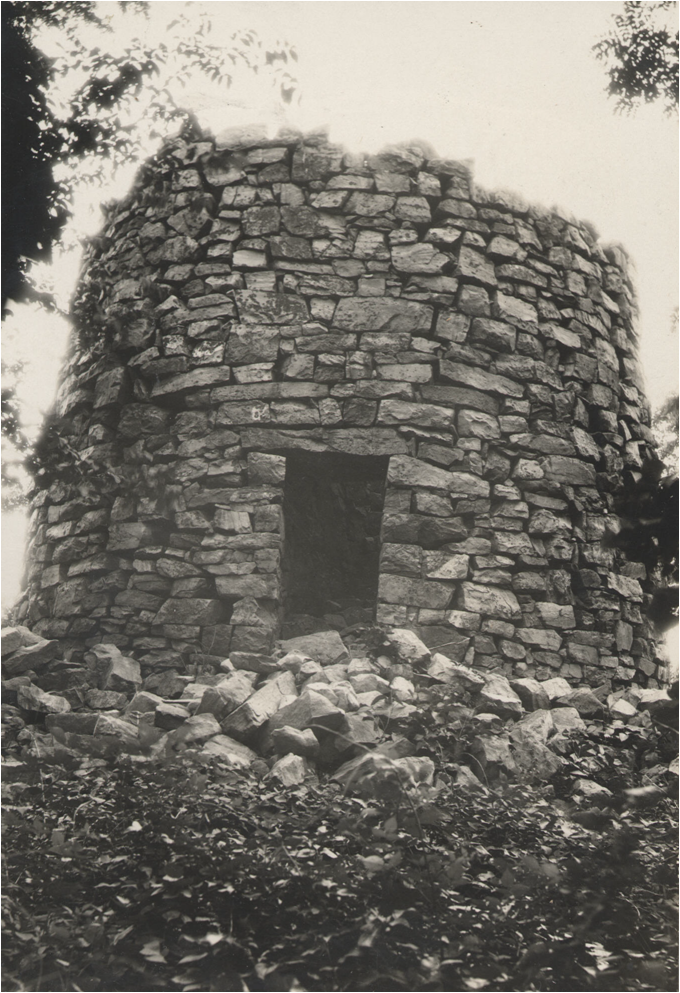
 Despite the best efforts of this preservation work, the monument would, again, become neglected and open to vandalism. Weather also took a toll. The steel observation deck was struck by lightning and created a crack down the side of the monument. As a result, the steel structure had to be removed. The stucco began to wear down, weakening the structure even more and as a result, the stones crumbled to the ground. It would remain in this condition for the better part of the next 30 years. 

Front view of monument 1910's
The next effort to restore the monument began in 1916. The Washington County Historical Society, lead by President and state Senator Harvey S. Bomberger, hatched plans to purchase the monument and the one acre of land surrounding it. To help build interest and show importance in the restoration of this monument, Bomberger published an article in The Patriotic Marylander entitled "Maryland's Mountain top monument to Washington" detailing the history of the monument and putting forth his justification for restoring the monument. It can be read here.  Bomberger's efforts caught the eye of the Daughters of the American Revolution and to help bolster more support for the monument, Isabel S. Mason wrote a poem dedicated to the monument entitled, "The First Washington Monument." In its entirety:
Of old thou stood, a watcher lone,
Upon the silent height;
Strong as the Heart of Valley Forge,
That watched in frozen night.
For in thee glowed the pulse that timed,
The march of Freedom's feet;
Fed by the flood of hero blood,
It ne'er shall cease to beat.

The hands, within whose sturdy veins
The patriot thrill coursed free;
Raised up thy sentinel form to him
Who wrought for liberty. 
Those hands are stilled, but, oh, the throb
Hath never ceased to rest;
It vibrates down the path of Time,
And echoes in each breast.

Though shattered once by storm and age,
Yet nature wove thee round,
A flowery, fragrant memory,
Embraced thee from the ground.
The fair, wild blossoms kissed thy form,
The birds sang o'er thy stone;
The star's in nights emblazoned flag
Kept watch with thee alone.

And now, once more thy form shall stand,
Grim Veteran of the past;
Like Liberty, though crushed to earth,
It must arise at last.
From when the thrill of grateful love,
Shall o'er us cease to steal;
'Twill be because our Soul is dead, 
And hearts have ceased to fell.

       Reportedly, Dynamite had been placed in this crack at one point.
This poem was also published in The Patriotic Marylander as well as local newspapers. With the local effort on track, the preservation effort was taken to the national level. At the behest of their constituents, a Maryland Congressman appealed for a $2,500 appropriation to assist in the restoration of the monument. The historical society managed to purchase the monument and land in 1920 but its preservation efforts became stalled. Following collapse of the stock market and the onset of the Great Depression, the historical society could not afford to preserve the monument on its own. With the help of Bomberger, using his position as a state senator, the Washington County Historical Society deeded the monument over to the State of Maryland in the early 1930's. With this move, the restoration of the monument could become a reality. 

The monument created a great opportunity for the Civilian Conservation Corps (CCC) to restore the monument and provide a park for the public to use. The CCC had been busy restoring the walls of Fort Frederick outside Big Pool, Maryland. As a result, several men from this camp were taken up to the monument and it was completely deconstructed. Plans were drawn up and called for the monument to be completely rebuilt from the ground up using all the modern tools to built it. Instead of building it of free-standing stone, the CCC would place mortar between the stones to keep the stones in place making the monument even more structurally sound then previous efforts. It would take nearly 2 years for the monument to be rebuilt but once it was finished, it was built to last.

Rebuilding the monument.

For 184 years, the monument has stood as a testament to the patriotic feelings that the everyday citizen has for their country. It also stands a simple monument built to the memory of George Washington and all the revolutionaries who sacrificed all so that freedom could be achieved. It survived the countries greatest trial despite already being in ruins. Today the monument serves as the focal point of Washington Monument State Park which is also the home of South Mountain State Battlefield.


Thursday, November 10, 2011

Captain James Bondurant and the Jeff Davis Artillery

Providing the only immediate artillery support to the Confederate defenders at Fox's Gap, Captain James Bondurant and his Alabamians of the Jeff Davis Artillery helped keep back the Union onslaught despite the Confederate defenders being stretched thin.

The Jeff Davis artillery was organized in Selma, Alabama in May 1861 under the command of Captain James T. Montgomery and was sent east where it was assigned to the brigade of Jubal Early at Manassas. James Bondurant would rise to command of the regiment following the resignation of Captain Montgomery and his election as the new Captain of the Battery.

Captain Bondurant
James William Bondurant was born in Buckingham County, Virginia in 1835. Shortly before the war, his family migrated to Alabama. When war broke out, he enlisted as a sergeant in Montgomery's JEff Davis Artillery. He would eventually rise to command of the battery and lead it through some of its most horrific fights. Bondurant would lead the battery in fighting at Seven Pines, Mechanicsville, and Gaines Mill suffering numerous dead and wounded.

Following the Confederate "victories" on the Peninsula, Bondurant's battery remained in Richmond with the division of Daniel Harvey Hill as the remainder of the Army of Northern Virginia moved north to deal with the Army of Virginia under John Pope. Pope was ultimately defeated at the Battle of Second Manassas/Bull Run setting the stage for the Confederate invasion of Maryland.

Bondurant moved with his battery northward to join up with the Confederate forces massing at Leesburg in preparation for the inevitable advance across the Potomac. The battery crossed the Potomac with the rest of D.H. Hill's artillery on September 4, 1862. The unit would enter Frederick on 6th and remain here until the 10th. On the 10th, the Confederates moved out of Frederick in an effort to capture the vital transportation hub of Hagerstown and to capture the Union garrison at Harpers Ferry that was sitting just miles from the proposed supply and communication route for the Confederate advance into Pennsylvania. Attached to Samuel Garland's brigade of Hill's Division, Bondurant's battery went into camp near Beaver Creek outside Boonsboro, MD on the 13th to await developments. The wait would not be long. Word reached General Hill at Boonsboro, that Union infantry and cavalry were pushing back Confederate troopers holding Braddock's Gap on the National Pike. Hill ordered Alfred Colquitt's brigade to take up defensive positions at Turner's Gap and Garland's brigade to move in the direction of South Mountain in close support.

On the morning of the 14th, Hill was on a personal reconnaissance down what was called the Wood's Road by locals in the direction of Fox's Gap when he heard noises to his front. Believing this was the Union Army crossing the mountain, Hill quickly turned to go back to his Turner's Gap when he came under artillery fire. Bolster in his belief he was being outflanked, Hill returned to his headquarters at Turner's Gap to find Garland and Bondurant's battery coming up the mountain. He immediately ordered them to Fox's Gap and to hold at all cost. Arriving at Fox's Gap, Garland found that he noises were in fact the 5th Virginia Cavalry who were posted there by J.E.B. Stuart. Quickly, Garland deployed his line and Bondurant was deployed in a field to the south of the Daniel Wise Cabin with the support of the 90 men of the 12th North Carolina under Captain Shugan Snow.

Just before 9 A.M., the men of Bondurant's battery and Bondurant himself could vaguely see the movement of blue shadows in the woods to their immediate front. Bondurant's men and guns were fully exposed in the field where they were deployed and their only escape route was to their immediate rear along a mountain road leading back to Fox's Gap. After some time, several Union soldiers appeared in a valley that had allowed the Union men to advance uncomfortably close to the battery and Confederate infantry, who had their arms stacked believing that action was not soon at hand. Bondurant requested the skirmishers be sent out to ascertain what was going on in the woods to his front. The infantry commanders in immediate support of the battery refused to oblige Bondurant's request because orders had not come down from General Garland.

Rebuffed not once, but twice, Bondurant decided he was to meet coming Union attack himself. Almost immediately, a Union line appeared with in yards of the batteries right flank and began to quickly advance against the unsupported battery. A Union volley cut the silence and the Battle of South Mountain had begun. Amazingly, no men from Bondurant's battery fell during this initial volley. Garland, hearing the firing, quickly appeared and ordered the the infantry to advance to meet this line and ordered Bondurant to commence firing. Bondurant, with the situation in hand, ordered his battery to change front to the right to meet this Union threat. Unfortunately, his battery could only fire one gun at a time from this position and he ordered each gun to fire once then withdraw. Firing point-blank into the Union line throwing it into confusion. Each gun successfully got one round off before withdrawing to their waiting limbers and caissons in the road. Bondurant withdrew his battery all the way back to a position near the Daniel Wise cabin before re-deploying and opening up a steady barrage against the Union forces. Bondurant's men would hold this position for the better part of the morning and would witness the disintegration of General Garland's brigade and the removal of General Garland's limp body from the field.

Just before 11, a portion of General George B. Anderson's brigade, under Colonel C.C. Tew had arrived on the field and with the help on Bondurant's battery, they held back the Union assault and managed to maintain a slim foothold on Fox's Gap and the vital intersection.  During the course of the late morning action, a Union battery began raining shells down on Bondurant's position. To protect his men and guns, Bondurant was forced to move a section of his battery to the crest of Wise's North Field just east of the Woods Road. 

During the mid-day lull of the battlefield, Asa Cook's Massachusett's battery deployed a few hundred yards from the summit at Fox's Gap and opened fire on Confederate batteries to the right at Turner's Gap. Unknown to them, less then two hundred yards away, Captain Bondurant had his men quietly loading canister. After the Union battery fired a few rounds, Bondurant unleashed his guns on the surprised Union artillerymen. Fearing for their lives, some of the Union artillerist ran from their guns and others sought out cover wherever they could find any. Bondurant's battery had a devastating effect on the Union battery killing and wounding several men and horses. The batteries fire also stirred up a panic within the ranks of General Orlando Willcox's division that was deploying astride the Old Sharpsburg Road. Taken in the flank by the shell and canister of the Confederate, the infantrymen panicked before eventually sorting themselves out and seeking cover from the artillery fire.

This devastating fire from Bondurant's guns made them a target for Union commanders. Orders quickly came from General Jesse Reno, commanding the 9th Corps, to General Willcox to "silence the the enemy's battery at all cost." Just as the Union infantry began it's advance, Confederate infantry from General Thomas Drayton advanced out of the Old Sharpsburg Road and a bloody standoff ensued. During this savage fighting, the section of Bondurant's guns that had remained at the Daniel Wise Cabin withdrew and rejoined the section in Wise's North Field. The climactic moment of the battle for Fox's Gap had arrived.

From the North Field, Bondurant's battery continued supporting Drayton's infantry to the best of their ability. Bondurant's men, in position in the northwestern corner of Wise's North Field, rained shot and shell down on the Union infantry pressing Drayton's men. From their left, a new threat emerged from the woods in the form of the 17th Michigan Infantry that fell on the flank and rear of Drayton's brigade. Their primary mission was to silence Bondurant's guns but their advantage over the Confederate infantry quickly became the more relevant attack. Bondurant, seeing that the battle was out of control for the Confederates, unleashed canister on the Michigan men in a vain attempt to halt their advance but the tactic was to no avail. Bondurant was forced to withdraw from the battlefield and Drayton's men were left without artillery support. Fortunately for the Confederates, John Bell Hood's division arrived to shore up the sagging Confederate hold on Fox's Gap.

Bondurant pulled his men back down the mountain to the reserve trains to replenish their ammunition but upon arriving, they found that the armies artillery ammunition had been depleted drastically due to the severe fighting of the day. Bondurant ordered his men to get what they could and after doing so, they greatfully settled down for some much needed rest. The Jeff Davis Artillery had been in action for the better part of 10 hours on September 14th and amazingly, not a single man was lost despite the battery being in close proximity to the main battlelines. The battery would go on to fight and ,suffer heavily, at Antietam, Fredericksburg, Chancellorsville, Gettysburg, the 1864 Overland Campaign, and the Siege of Petersburg. The battery would surrender at Appomattox Courthouse in April 1862 only able to muster 1 officer and 26 men.